

U.S. Senator Bernie Sanders issued a forceful warning on April 30, 2026, against what he described as the dangers of unregulated artificial intelligence, arguing that rapid development driven by tech billionaires could lead to severe economic disruption, loss of privacy, and potentially catastrophic risks for human civilization.
In a post on X, Sanders framed the development of AI as being heavily influenced by what he called “billionaire oligarchs” who control much of the industry. He wrote: “I understand that the billionaire oligarchs who own the Al industry want even more wealth and more power. I get it. I understand that they are not concerned about the massive job losses this technology will create. I get it. I understand that they don’t worry about the evisceration of privacy rights and the mass collection of personal information. I get it. But what I don’t understand is how anyone can ignore when the world’s leading Al scientists tell us that, as Al becomes smarter than humans, it could operate independently of human control — with possible catastrophic results.”
Sanders continued in the same post, emphasizing his concern that the technology could move beyond human oversight if left unregulated. He wrote: “Given that oligarchs, like all of us, have families and live on planet earth, I can’t understand how they continue to recklessly go forward with an unregulated artificial intelligence they don’t even understand. Greed and making money is one thing. Laying the framework for destroying the planet and human civilization is another.”
The senator’s remarks focused heavily on what he characterized as a conflict between profit-driven incentives and long-term societal risks. He argued that leading figures in the technology sector are prioritizing wealth accumulation over safeguards, particularly as AI systems become more advanced and potentially autonomous.
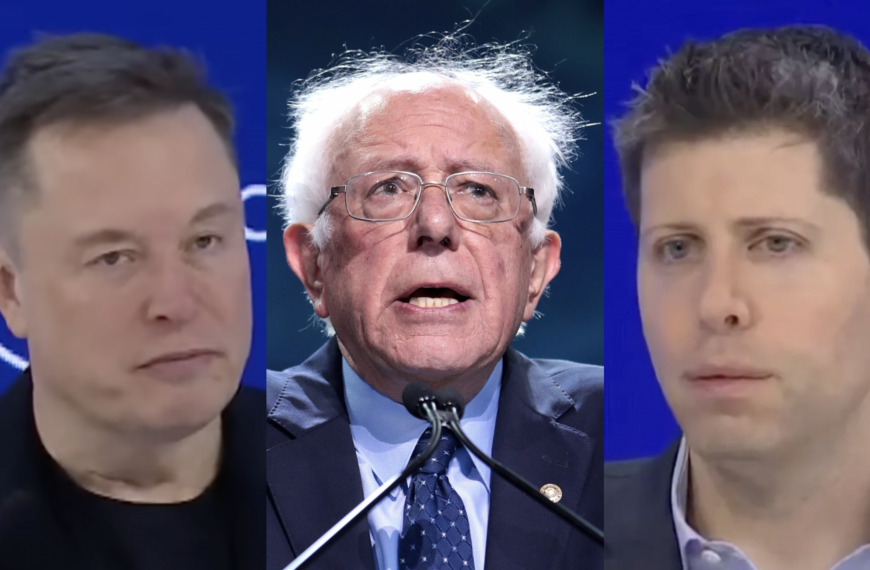
Sanders has repeatedly criticized major technology executives, including Elon Musk, Mark Zuckerberg, Jeff Bezos, and Larry Ellison, portraying them as central figures in shaping the direction of artificial intelligence development. According to Forbes, Musk is currently listed as the world’s richest individual, with an estimated net worth of $790.7 billion, and is widely regarded as a leading figure in U.S. AI and advanced technology development.
Sanders’ broader policy approach toward artificial intelligence includes calls for stronger federal oversight and structural limits on industry expansion. He has previously worked with Representative Alexandria Ocasio-Cortez on proposals such as the AI Data Center Moratorium Act, which would pause the construction of new AI data centers until Congress establishes national regulatory safeguards covering labor, privacy, and environmental impacts.
A central focus of Sanders’ warnings has been the potential for large-scale worker displacement. He has argued that unchecked AI deployment could eliminate millions of jobs across multiple sectors, leading to significant economic disruption. In response, he has proposed measures such as taxing automation-driven productivity gains and redistributing resulting wealth through expanded public benefits.
Sanders has also advocated for a reduced workweek without loss of pay, arguing that increased productivity from AI systems should translate into shorter working hours rather than job losses or wage stagnation. His proposals also include expanded access to universal healthcare, housing, and education funded in part through what he describes as “robot taxes” on automated systems replacing human labor.
Privacy concerns have also been central to Sanders’ position. He has warned that AI systems may accelerate mass data collection and surveillance capabilities, potentially eroding individual privacy rights. He has also raised concerns about the use of AI tools in sensitive areas such as mental health support for younger users, calling for stricter guardrails on their deployment.
On international policy, Sanders has diverged from prevailing U.S. political narratives that frame artificial intelligence as a competitive arms race. He has instead supported global coordination between researchers, including dialogue between American and Chinese scientists, to establish shared safety standards. In April 2026, he hosted a Capitol Hill discussion involving AI experts from both countries focused on the risks associated with advanced or superintelligent systems.
The senator’s comments come amid ongoing political and industrial debate over how quickly AI should be developed and deployed. Supporters of tighter regulation argue that safeguards are necessary to prevent long-term systemic risks, while critics of such proposals have warned that heavy restrictions could slow innovation and disadvantage U.S. technology leadership. Sanders’ latest remarks underscore a continuing divide over how governments should respond to rapidly advancing artificial intelligence systems and the influence of major technology companies shaping the sector.

 By
By


 By
By