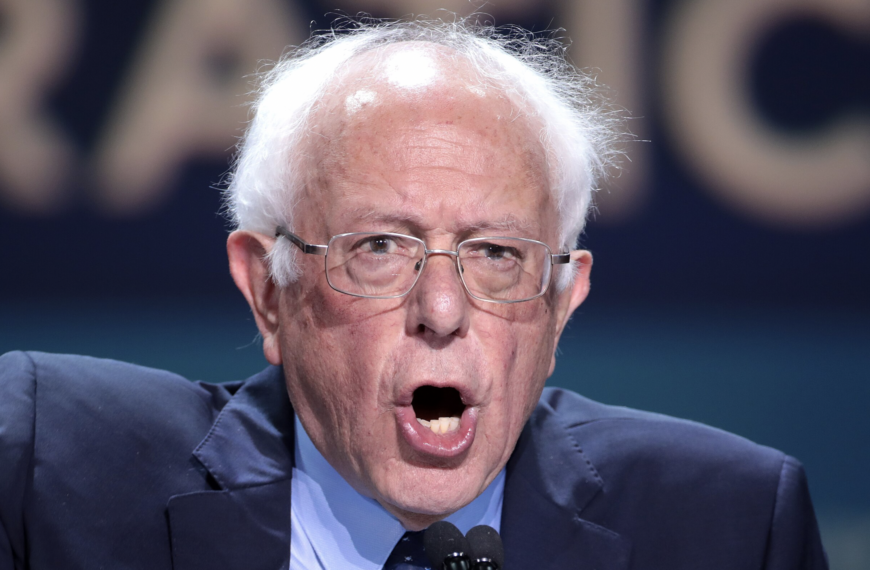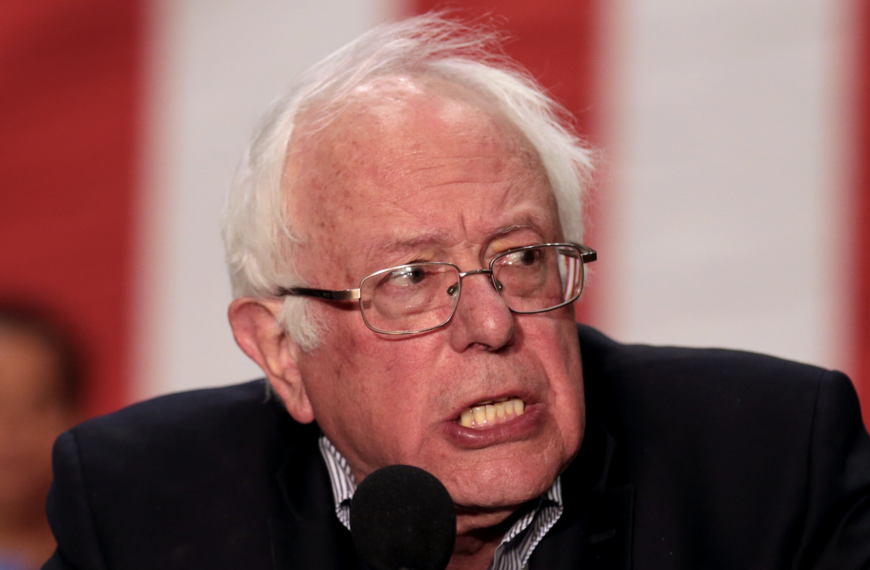
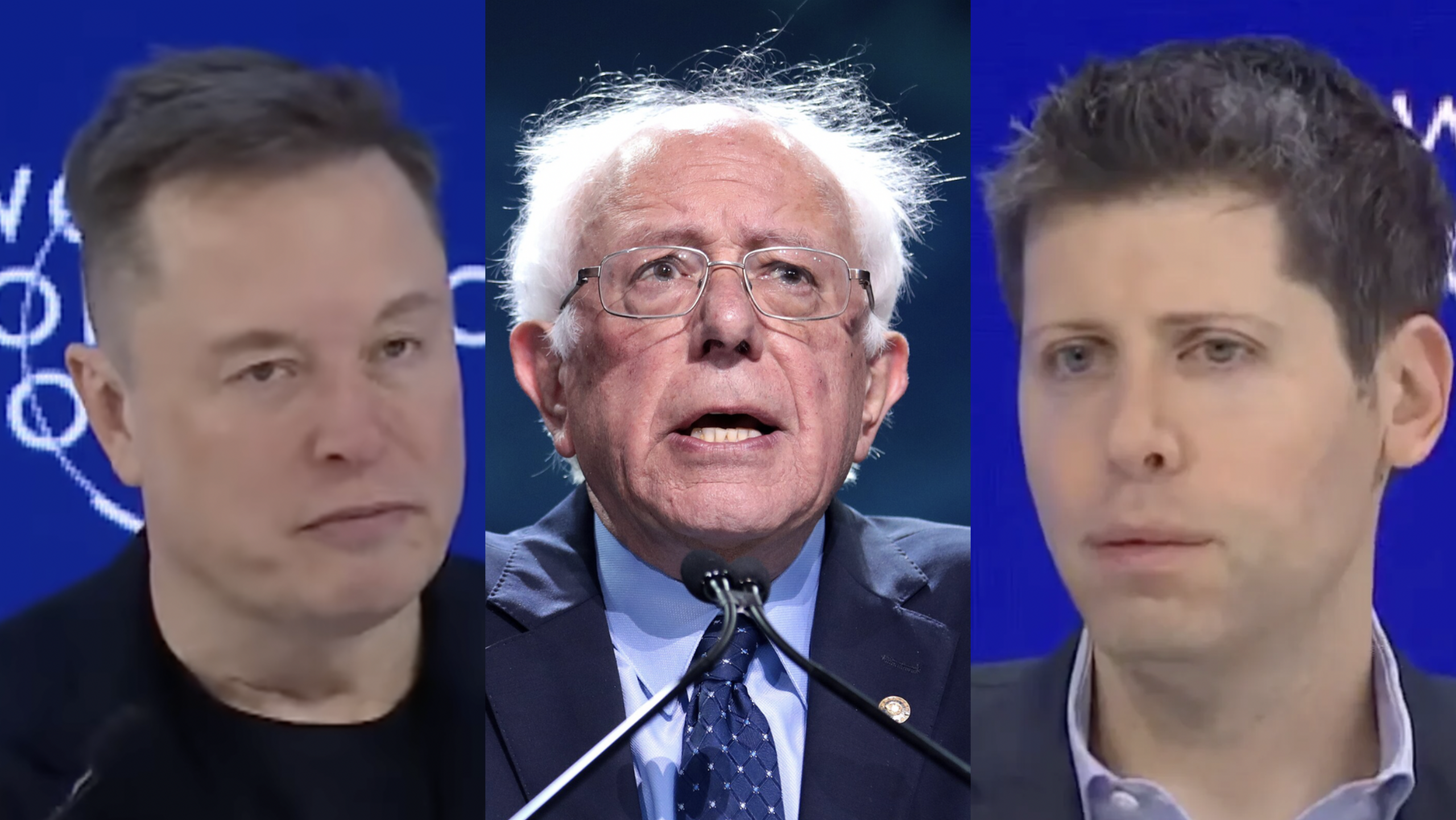

Senator Bernie Sanders (I-Vt.) drew a direct line on June 1, 2026 between the enormous personal fortunes being built by the men at the top of the artificial intelligence industry and what he described as the unconsented use of humanity’s collective knowledge — arguing that the wealth generated by AI technology does not belong to Silicon Valley, but to the public whose creativity, labor and intellectual output made it possible.
Writing in a New York Times op-ed, Sanders named names. He singled out OpenAI chief Sam Altman, Elon Musk — who leads the AI company xAI in addition to Tesla and SpaceX — and Anthropic CEO Dario Amodei as the executives whose companies are “positioned to dominate the industry,” and accused the broader class of tech investors and executives of treating artificial intelligence as “the next great wealth-extracting machine.” His proposed solution: legislation that would give the federal government a 50 percent equity stake in the largest AI companies in the United States and redirect those gains through a publicly owned sovereign wealth fund.
The Billionaires at the Top of the AI Economy
The wealth at stake in this debate is not abstract. According to Forbes’ real-time billionaire list, Elon Musk — whose corporate portfolio now includes xAI alongside Tesla, SpaceX and other ventures — holds a net worth of approximately $824.3 billion as of June 1, 2026, ranking him the single wealthiest person on earth. Musk’s fortune represents not just personal wealth but structural power over industries that are rapidly converging with AI, from electric vehicles to aerospace to social media.
Sam Altman, who leads OpenAI — the company behind ChatGPT and now valued at approximately $730 billion following a February 2026 funding round — is ranked 1,224th on Forbes’ real-time billionaire list as of June 1, 2026, with a net worth of $3.5 billion. That figure, however, carries an important asterisk: court filings from the ongoing Elon Musk v. OpenAI lawsuit, heard in May 2026, confirmed that Altman holds no direct equity in OpenAI itself. His wealth is built largely from a diversified investment portfolio, led by a stake in nuclear fusion startup Helion Energy valued at approximately $1.7 billion. The gap between Altman’s personal net worth and the company he runs illustrates both the unusual governance structure of OpenAI and the extraordinary concentration of AI-driven value in the hands of the company’s outside investors — including Microsoft, whose roughly $13 billion investment in OpenAI has grown to a stake worth an estimated $228 billion.
“Stolen” Knowledge
Sanders’ core argument is not simply that these men are wealthy, but that their wealth has been built, in part, on a foundation they did not create and did not pay for. The datasets that power large language models and generative AI systems were assembled from books, articles, academic research, source code, artwork, journalism, music, and the full breadth of recorded human expression — generated over generations by millions of people who were never asked, never credited and never compensated.
“For the most part, tech oligarchs have fed this knowledge into their A.I. models without permission, without acknowledgment, without compensation,” Sanders wrote. “The creative work of millions of people — writers, artists, musicians, journalists, teachers, scientists and ordinary citizens — has essentially been stolen by some of the wealthiest people in the world.”
The senator marshaled the industry’s own words as evidence. OpenAI’s Altman has publicly stated that AI models were trained on humanity’s “collective experience, knowledge” and “learnings.” Sanders argued that this admission makes the moral claim for public ownership not just defensible but logically inescapable — if the technology was built on collective human output, then the wealth it generates belongs to that same collective.
The Proposed Remedy
To reclaim what he characterized as a transferred public resource, Sanders announced plans to introduce the American A.I. Sovereign Wealth Fund Act — legislation that would impose a one-time 50 percent stock levy on OpenAI, Anthropic, xAI, and other leading AI firms. Rather than taxing profits in a conventional sense, the bill would require those companies to transfer half their equity directly into a federally administered fund held on behalf of the American public. In exchange, the government would receive voting shares and equal board representation at each company, giving citizens a formal role in shaping how the technology is developed and deployed.
“Since A.I. is built on the collective knowledge of humanity, the wealth it generates must benefit humanity,” Sanders wrote. “Not just Mr. Musk, Mr. Altman, Dario Amodei and other moguls whose companies are positioned to dominate the industry.”
A Precedent the Industry Endorsed
One of the sharpest edges of Sanders’ argument is that it does not rely solely on progressive politics for support — it relies, in part, on the AI companies themselves. Sanders noted that OpenAI has previously proposed the creation of a “public wealth fund that provides every citizen — including those not invested in financial markets — with a stake in A.I.-driven economic growth.” Anthropic made a comparable proposal, calling for “national sovereign wealth funds with stakes in A.I.” Even Musk, whose $824 billion fortune would be directly affected by the legislation, wrote publicly that “Universal HIGH INCOME via checks issued by the Federal government is the best way to deal with unemployment caused by AI.”
The senator cited each of these positions directly — using the industry’s own public statements to argue that his bill is not a radical departure from the direction even its targets have gestured toward, but a concrete mechanism to actually deliver on it.
Norway, Alaska and the Public Wealth Model
Sanders placed the proposal within a well-established tradition of sovereign wealth funds used by governments around the world to ensure that national resources generate broad-based prosperity rather than private profit. Norway’s government fund, built from the country’s oil revenues, is now worth more than $2 trillion. Alaska has distributed annual dividends to its residents for decades through a state fund seeded by oil royalties. Public pension funds across the United States already hold hundreds of billions of dollars in corporate equity. Even President Donald Trump has signed an executive order calling for the creation of an American sovereign wealth fund, though without a specific AI focus.
“When a public resource generates wealth, the public should share in that wealth,” Sanders wrote. “A.I. is being built on a public resource far more valuable than oil: the accumulated knowledge, creativity and labor of mankind.”
Democratic Control Over a Technological Revolution
Sanders has been pressing this argument with increasing urgency throughout 2026. In an April op-ed published through his Senate office, he wrote that the American people “don’t trust the AI oligarchs” and that they understand the AI revolution is being driven by billionaires investing not to improve working families’ lives but to “expand their own wealth and power.” In March, he and Rep. Alexandria Ocasio-Cortez (D-N.Y.) introduced the AI Data Center Moratorium Act, which would impose a federal halt on new AI data center construction until national safety, labor, and environmental safeguards are in place — legislation they described as an effort to let democracy catch up with technology that is advancing faster than any regulatory framework.
The wealth fund legislation, Sanders said, would serve as the financial and democratic counterpart to those safeguards — not just slowing the most reckless elements of AI deployment, but structurally redirecting where its rewards land. The proceeds of the fund, he wrote, would first provide direct payments to the American people, and as the fund grows alongside the projected multi-trillion-dollar AI economy, its returns would be used to guarantee health care, education and housing for every citizen.
“The future of A.I. and the fate of humanity must not be decided behind closed doors in Silicon Valley,” Sanders wrote. “It must not be dictated by billionaires seeking to maximize their power and profit. It must be decided by workers, parents, teachers, artists, scientists, communities and the American people. It’s our future. We must decide it.”

 By
By

 By
By