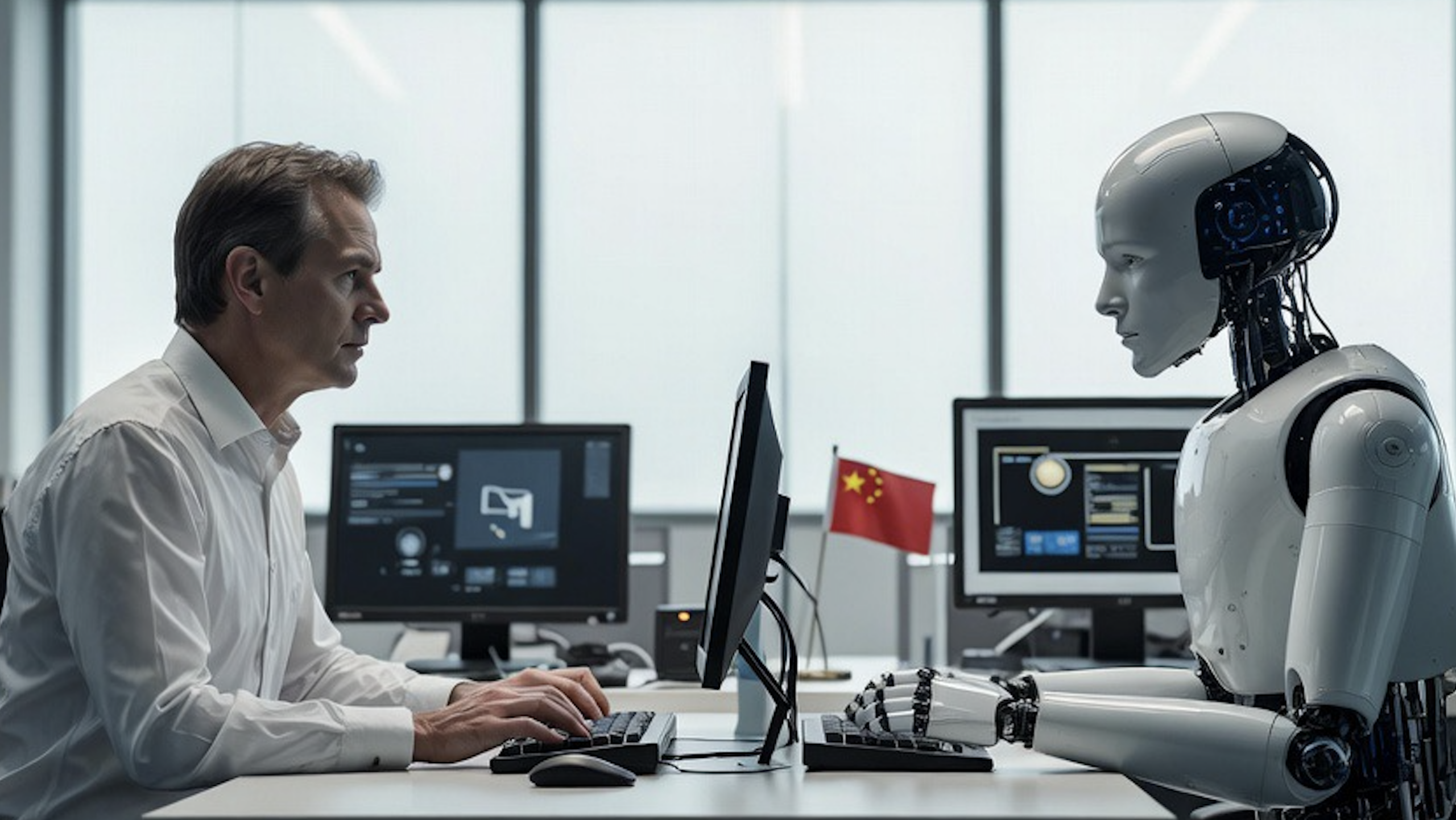

A Chinese court has ruled that companies cannot dismiss employees simply for replacement by artificial intelligence, siding with a tech worker in a dispute that experts say highlights growing legal and labor tensions in the era of rapid automation.
The decision was published Tuesday by the Hangzhou Intermediate People’s Court in Hangzhou, a major artificial intelligence hub in Zhejiang Province, alongside a set of “typical examples of protecting the rights of AI enterprises and workers” ahead of International Workers’ Day on May 1. The ruling upheld a lower court judgment that found the dismissal of a senior technology employee unlawful, rejecting the company’s claim that AI-driven restructuring justified termination.
The case centered on a worker surnamed Zhou, who joined an AI-related technology company in November 2022 as a quality assurance supervisor with a monthly salary of 25,000 yuan (about 3,640 U.S. dollars). His responsibilities included aligning user queries with large language models and filtering illegal or privacy-violating content to improve the accuracy and safety of AI systems.
According to the court file, Zhou’s role was later gradually taken over by large language models. The company then proposed reassigning him to a lower-level position with a reduced monthly salary of 15,000 yuan. Zhou refused the change. The company subsequently terminated his contract, offering 311,695 yuan in compensation and citing organizational restructuring and reduced staffing needs.
Zhou challenged the compensation amount through arbitration, arguing for higher damages. The arbitration panel ruled that the dismissal was unlawful and supported his claim for additional compensation. The company, dissatisfied with the outcome, escalated the dispute to a district court in Hangzhou in August 2025, and later appealed to the Hangzhou Intermediate People’s Court.
At the core of the case was whether AI-driven job replacement constitutes a “major change in the objective circumstances” under China’s Labor Contract Law, a legal standard that can justify termination. The court concluded that the company’s justification did not meet this threshold, which is typically reserved for major events such as relocation, mergers, or similar structural disruptions. It further found that the employer failed to demonstrate that Zhou’s employment contract had become impossible to perform.
The court also determined that the reassignment offered to Zhou, which came with a substantial pay cut, was not reasonable. As a result, the termination was ruled unlawful.
Wang Xuyang, a lawyer from Zhejiang Xingjing law firm, said the ruling clarifies an important principle in the context of automation-driven restructuring. He stated that while companies may benefit from efficiency gains brought by AI, they also bear corresponding social responsibilities, adding that “AI replacement does not automatically justify terminating a labor contract.”
The ruling aligns with earlier administrative and arbitration decisions in China addressing similar disputes. In a prior case released by the Beijing Municipal Bureau of Human Resources and Social Security, an AI-related dismissal involving a map data collector was also deemed unlawful. The arbitration panel in that case found that the employer’s use of AI to replace human labor was a voluntary business decision and could not be used to shift the risks of technological change onto employees.
The Hangzhou case comes amid broader debate in China over how AI adoption intersects with labor protections. Official data cited in the report show that China’s core AI industry surpassed 1.2 trillion yuan in 2025, with more than 6,200 related enterprises, and projections suggest that the penetration rate of next-generation intelligent systems could exceed 90 percent by 2030.
The rapid expansion of AI has raised concerns about potential misuse of automation in workforce reductions. Media reports have described cases such as companies using AI-generated digital replicas of former employees to continue performing tasks, fueling discussion about the boundaries of employment law and emerging technologies.
Wang Tianyu, a researcher at the Chinese Academy of Social Sciences, noted that these developments are raising fundamental legal questions, including who qualifies as a legal subject in employment relationships and how personality rights should be defined in AI-driven workplaces. He stated that “technological progress may be irreversible, but it cannot exist outside a legal framework,” emphasizing the need for forward-looking legal safeguards to protect worker dignity and rights.
Legal scholars have similarly stressed that the costs of technological transformation should not fall solely on workers. They argue that AI adoption should not be used as a justification for layoffs or to avoid employer obligations, while also encouraging workers to adapt through skills upgrading.
Pan Helin, an economist and member of an expert committee under China’s Ministry of Industry and Information Technology, said that although AI-driven displacement may be unavoidable, companies are expected to ensure fair transition measures, including reasonable reassignment and adequate compensation in cases of termination.
China’s government work report this year also highlighted the need to improve employment and entrepreneurship measures in response to AI development, signaling the integration of automation’s labor impact into national policy planning. Meanwhile, Goldman Sachs researchers warned in a 2025 report that “it’s early days for AI adoption, and the impact on jobs will largely depend on how employers ultimately put the technology to best use,” underscoring uncertainty around the long-term labor effects of artificial intelligence.

 By
By



 By
By