

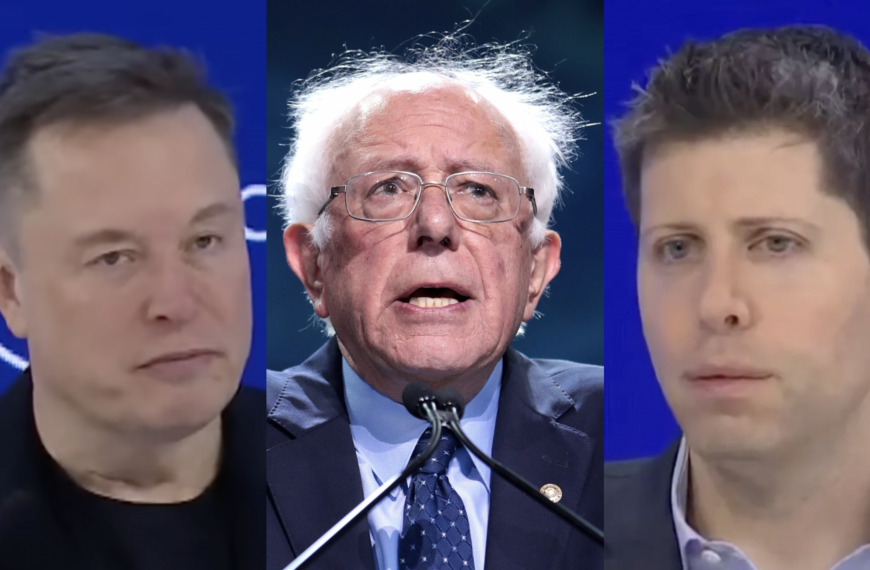
Senator Bernie Sanders emphasized the need for artificial intelligence to benefit the broader workforce rather than concentrate wealth and power among the ultra-rich, arguing that significant technological shifts must be shaped by policies that protect working people. Sanders challenged tech billionaires’ motives in advancing AI, warning that without thoughtful oversight, the technology could exacerbate job losses and deepen economic inequality. His comments came amid his ongoing campaign in California to advance a proposed “billionaire tax”. In his post Sanders wrote, “Do you think Elon Musk, Mark Zuckerberg and Jeff Bezos are investing in AI to help the working class of this country? No, they’re in it to accumulate even more wealth and power for themselves. We’ve got to make AI work for working people, not just for billionaires.”
Do you think Elon Musk, Mark Zuckerberg and Jeff Bezos are investing in AI to help the working class of this country?
— Sen. Bernie Sanders (@SenSanders) February 20, 2026
No, they’re in it to accumulate even more wealth and power for themselves.
We’ve got to make AI work for working people, not just for billionaires. pic.twitter.com/kaYqQDzscJ
On CNN’s Elex Michaelson show Sanders argued that developments in artificial intelligence and robotics are being driven primarily by what he described as “oligarchs,” naming figures such as Musk, Zuckerberg and Bezos. “You have to understand that AI and robotics are being pushed once again by these same oligarchs,” Sanders said. “Do you think that these guys are staying up nights worrying about the working class, about the jobs that are going to disappear? It’s literally to get rid of the jobs… They’re in it for the wealth and the power.” Sanders called for slowing the pace of AI adoption to ensure that its benefits accrue to “ordinary people, the working people, not just for billionaires,” reflecting broader concerns about automation displacing jobs and widening economic disparities.
Sanders also tied his AI critique to his support for a ballot measure in California that would impose a one‑time tax on residents with wealth exceeding $1 billion, a proposal aimed at addressing state budget shortfalls and funding public services.
Sanders highlighted the harsh disparities in wealth between the billionaire class and average Americans. According to Forbes, Elon Musk is the world’s richest person with an estimated net worth of $834.9B, far exceeding that of other top tech magnates. Jeff Bezos, founder and executive chairman of Amazon and the space company Blue Origin, ranks among the top wealth holders with a net worth of $226.6B, while Mark Zuckerberg, chief executive of Meta Platforms, whose wealth derives largely from his leadership of the company that owns Facebook, Instagram and WhatsApp has an estimated net worth of $221.2B.
Beyond wealth figures, each of these executives is deeply involved in AI. Musk’s ventures include Tesla, which integrates AI in autonomous driving technologies, and xAI, a company he co‑founded to develop advanced artificial intelligence systems. Bezos’s Amazon uses AI across cloud computing services and logistics, and he is involved in Project Prometheus, a startup focusing on AI engineering and manufacturing. Zuckerberg’s Meta has invested heavily in AI research and development, integrating machine learning into its social platforms and pushing into AI‑driven virtual reality and augmented reality experiences.
Sanders’s remarks also delved into broader political dynamics, including divisions within the Democratic Party over how best to address economic inequality and technological change. He asserted that a fundamental choice faces the party: whether it sides with the interests of wealthy elites or with working‑class Americans who face stagnant wages and job insecurity. In presenting his vision for the future, Sanders reiterated that AI has the potential to transform economies and societies but stressed that its trajectory should be shaped to protect employment and ensure broad social benefit.

 By
By


 By
By