


Elon Musk already occupies a financial category few individuals in modern history have approached, but a potential public offering of SpaceX could push his wealth into territory no person has ever reached. If public markets assign the company the kind of valuation analysts and investors have been discussing, the conversion of Musk’s private stake into publicly traded equity could rapidly propel his fortune toward the trillion-dollar threshold, a milestone that has never been achieved by a single individual.
The possibility centers on a widely discussed SpaceX initial public offering that analysts believe could be one of the largest listings ever attempted. Recent reporting indicates the company could seek to raise well over $30 billion from investors, a scale that implies a total valuation reaching into the upper hundreds of billions of dollars and potentially approaching $1.5 trillion. At that level, Musk’s majority ownership would be translated into a massive pool of publicly priced stock once trading begins.
One detailed financial analysis of a hypothetical $1.5 trillion valuation suggests Musk could come close to becoming an instant trillionaire if such a listing occurs. Because publicly traded companies are valued continuously by the market, the price investors place on SpaceX shares would directly determine the real-time value of Musk’s holdings, similar to how his stake in Tesla is measured today. In optimistic scenarios where investor demand matches the most aggressive forecasts, the combined value of his equity could push his personal fortune close to or even beyond the trillion-dollar mark.
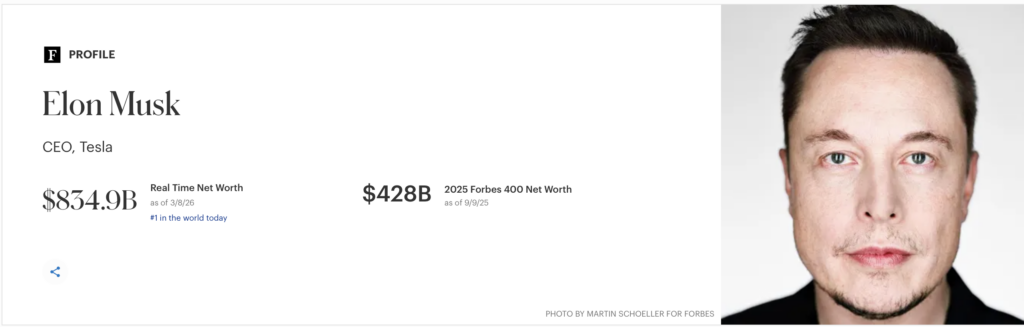
Current wealth estimates illustrate how dramatic that shift could be. According to Forbes’ real-time billionaire rankings as of March 8, 2026, Musk’s net worth stands at approximately $834.9 billion, placing him firmly at number one globally. Even without a SpaceX listing, his wealth already far exceeds that of other billionaires, driven largely by his ownership in companies spanning electric vehicles, space technology, artificial intelligence, and satellite communications.
The extraordinary valuation expectations surrounding SpaceX stem from the company’s unusual position within the aerospace and technology sectors. Founded by Elon Musk in 2002 as Space Exploration Technologies Corp., the company was built around the goal of reducing the cost of space transportation and ultimately enabling human settlement on Mars. Over the past two decades it has developed reusable rocket systems, constructed a global satellite internet network through Starlink, and positioned itself as a central player in commercial space infrastructure.
Investors increasingly view that combination of launch capability, satellite services, and long-term space ambitions as the kind of platform that public markets reward with premium valuations.
For now, SpaceX remains privately held, meaning most of Musk’s stake is tied up in illiquid shares that cannot be traded freely on public exchanges. Investors seeking exposure have largely relied on private transactions or indirect holdings, which limits how directly market enthusiasm can influence Musk’s publicly reported wealth. Musk has indicated in a post that SpaceX plans to pursue a public listing in the mid-to-late 2026 timeframe, a move that would finally open the company to broad public investment.
As usual, Eric is accurate
— Elon Musk (@elonmusk) December 10, 2025
If that timeline holds and markets deliver the valuation some analysts anticipate, the resulting shift in Musk’s net worth could mark a historic moment in global finance. A successful listing at trillion-dollar levels would not only cement SpaceX as one of the most valuable companies in the world, but could also make Elon Musk the richest person in history and the first individual whose personal fortune crosses the trillion-dollar threshold.

 By
By


 By
By