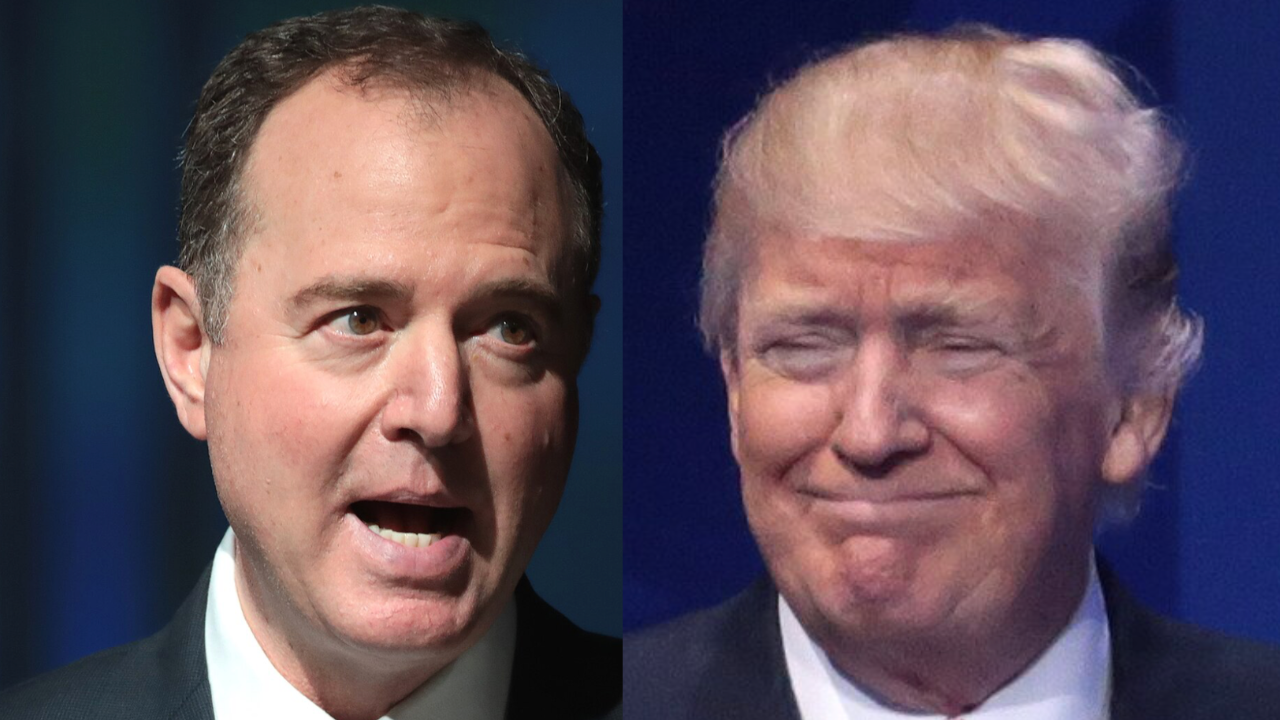

WASHINGTON, May 28, 2026 — Sen. Adam Schiff, D-Calif., accused President Donald Trump of using taxpayer money as a “wedding present” for his son Donald Trump Jr. on Wednesday, responding to a ProPublica investigation revealing that White House senior counselor Peter Navarro personally intervened to fast-track a $620 million Pentagon loan to a startup in which Trump Jr.’s venture capital firm held a stake.
“Trump may not have attended his son’s wedding, but now we know his wedding present: $600 million of your tax dollars to one of his companies,” Schiff wrote on X. “The Trump family grift knows no bounds, and neither should our resolve to stop it.”
The ProPublica investigation, published Wednesday by reporter Robert Faturechi, is based on interviews with Pentagon officials and a review of Defense Department records — and represents what the outlet described as the first time the awarding of a federal contract has been directly linked to White House intervention on behalf of the Trump family.
What ProPublica Found
According to ProPublica’s investigation, the $620 million loan to Vulcan Elements — a North Carolina rare-earth magnet startup founded in 2023 — was the only deal among dozens the Pentagon was considering that was initiated by a top aide to the president. That aide was Navarro, Trump’s senior counselor for trade and manufacturing.
After defense officials received the White House request, Pentagon staff were told to move at an “unusually rapid pace,” working “late nights and with little sleep” to complete the loan in a matter of weeks, a person involved in the deal told ProPublica. “The call came from the White House: We have to get this done,” the source said.
The timeline is central to the conflict-of-interest allegations. In August 2025, Vulcan announced $65 million in investments — including from 1789 Capital, the venture capital firm where Trump Jr. is a partner. Three months later, in November 2025, the Pentagon’s Office of Strategic Capital announced the $620 million conditional loan to Vulcan — the largest in the office’s history and nearly a hundredfold increase on what Vulcan had previously raised in total. Estimates of Vulcan’s valuation jumped from approximately $200 million at the time 1789 Capital invested to approximately $2 billion after the deal was announced.
The Navarro-Trump Jr. Relationship
Navarro and Trump Jr. have a close personal relationship that predates the Vulcan deal. Trump Jr. visited Navarro in prison while he served time for defying a congressional subpoena related to the January 6 investigation. Navarro dedicated his latest book to Trump Jr. for having “my back when it was against the wall.” A week before the Vulcan deal was publicly announced, Trump Jr. hosted Navarro on his streaming show “Triggered” — encouraging his nearly 2 million subscribers to buy Navarro’s book — in an episode in which the two also discussed rare earths and China’s dominance of the supply chain.
The White House said in a statement that the administration is working “in the best interest of the American people” and that “the President’s entire team, including Senior Counselor Navarro and officials at the Department of War, is working together and with private industry to secure America’s critical mineral supply chain at Trump Speed.” Navarro did not respond to ProPublica’s questions.
Denials From All Sides
Trump Jr.’s spokesperson said the president’s son “does not discuss companies he has invested in with federal government officials and did not speak to Navarro about Vulcan” and “has no knowledge about how this deal came together.” A spokesperson for 1789 Capital said the firm “played no role in Vulcan getting the loan and did not learn about the deal before it was public.” The Pentagon said: “No company receives preferential treatment. Outside affiliations, investors, or political connections play absolutely no role in the Department’s funding decisions.” Vulcan did not respond to ProPublica’s questions.
The Rare-Earth Context
The loan was made through the Office of Strategic Capital — a Pentagon division established under the Biden administration and dramatically expanded under Trump, with its lending authority growing from approximately $1 billion to $200 billion. The office funds private companies working on rare-earth elements and critical military technologies to reduce U.S. dependence on China.
The strategic rationale for the loan is not in dispute. China dominates global rare-earth processing — producing, as of last year, the world’s entire supply of samarium, an essential component of magnets used in Tomahawk missile guidance systems and F-35 fighter jet engines. China also restricted exports of some rare-earth metals last year, underscoring the national security risks of dependence on a single supplier.
Vulcan, which had fewer than 50 employees at the time of the loan announcement, makes rare-earth magnets needed for drones and satellites. It said it would use the funds to build a large new facility capable of producing thousands of tons of magnets per year and planned to add hundreds of jobs. The loan also came with $50 million in incentives from the Commerce Department and a $50 million government equity stake in Vulcan, with the right to purchase more later.
More Trump Jr. Deals Potentially Ahead
ProPublica also reported that among other companies under review for Pentagon loans is Unusual Machines — a Florida drone parts manufacturer on whose advisory board Trump Jr. sits and in which he holds millions of dollars worth of shares. The Pentagon was accused of cronyism last year when it awarded Unusual Machines a contract to make drone engines for the Army.
Congressional Response
Schiff was not the first Democrat to raise alarms over the Vulcan deal. A group of Democratic senators previously demanded the Pentagon explain how Vulcan was selected — the Pentagon’s response addressed only how it handles conflicts involving its own employees’ financial holdings, not those of the president’s family. House Democrats attempted to subpoena Trump Jr. to testify but were blocked by Republicans.
Richard Painter, the chief White House ethics lawyer during the George W. Bush administration, told ProPublica: “This is our money they’re spending. This is corruption we pay for.”

 By
By

 By
By