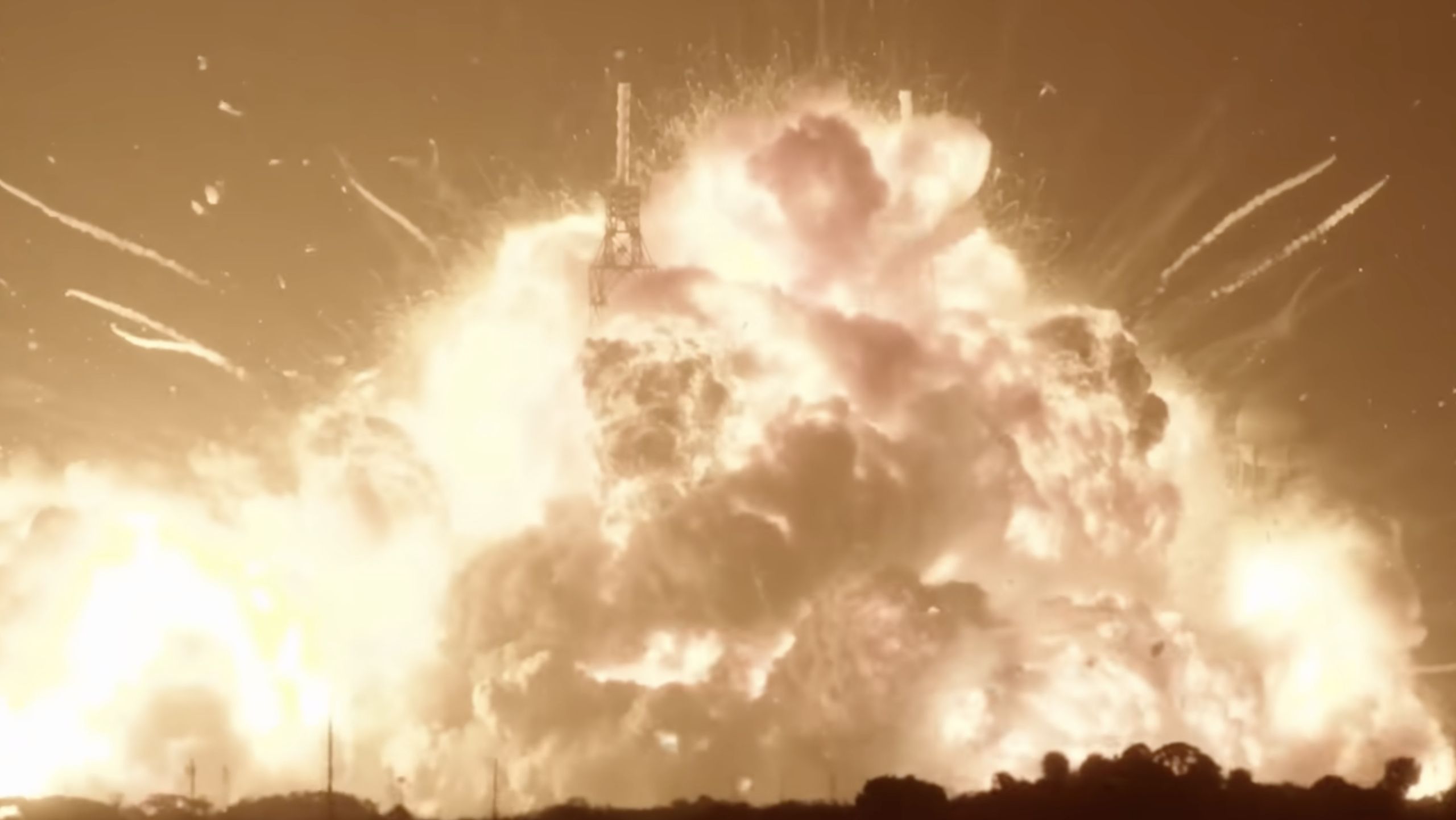

A 322-foot rocket belonging to Jeff Bezos’ space company Blue Origin was destroyed in a massive explosion on a Florida launchpad on Thursday night, sending a fireball into the sky visible from nearby beaches and shaking homes across Cape Canaveral and Cocoa Beach. The catastrophic failure, which occurred during a routine pre-launch engine test, has thrown the future of Amazon’s satellite internet constellation into question and dealt a potentially serious blow to NASA’s plans to return American astronauts to the Moon.
The explosion occurred around 9 p.m. EDT as engineers were counting down to a brief test firing of New Glenn’s seven methane-fueled BE-4 first stage engines at the Cape Canaveral Space Force Station. Blue Origin was preparing for what was to be the rocket’s fourth mission — a June launch to deploy a batch of Amazon’s “Leo” internet satellites into orbit. As the engines appeared to begin firing, something went wrong at the base of the rocket. The 188-foot-tall first stage became enveloped in a rapidly growing fire, and moments later, the 86-foot-tall upper stage could be seen tilting and starting to fall as the first stage apparently began collapsing, before the vehicle suddenly exploded as its load of methane fuel and liquid oxygen ignited.
“All Personnel Have Been Accounted For”
Blue Origin confirmed the incident shortly after it unfolded. “We experienced an anomaly during today’s hotfire test,” the company wrote on social media. “All personnel have been accounted for.” U.S. Space Force officials confirmed that emergency teams responded promptly and that there were no injuries or fatalities, adding that Space Force officials, Blue Origin, and other partners were analyzing data to identify the cause of the incident. The Federal Aviation Administration also weighed in, noting that the test “was not within the scope of FAA licensed activities” and that there was “no impact to air traffic.”
Bezos Responds: “It’s Worth It”
Bezos, whose net worth Forbes places at approximately $279 billion, making him one of the top five wealthiest individuals in the world, addressed the disaster directly on social media. “All personnel are accounted for and safe,” he wrote. “It’s too early to know the root cause but we’re already working to find it. Very rough day, but we’ll rebuild whatever needs rebuilding and get back to flying. It’s worth it.” The explosion is among the most significant setbacks for a company that Bezos founded in the year 2000 and has poured billions of dollars into over more than two decades.
The Only Launchpad — Gone
The scale of the physical damage compounds the crisis considerably. The rocket was destroyed, and as the smoke cleared, there was no sign of the erector-gantry used to move the New Glenn from its hangar to the pad and raise it vertical. The launchpad, known as Space Launch Complex 36 at Cape Canaveral Space Force Station, is the only launchpad Blue Origin has for the New Glenn rocket. The last major on-pad explosion at Cape Canaveral was back in September 2016, when a helium tank rupture caused a SpaceX Falcon 9 rocket to explode at Space Launch Complex 40. The Falcon 9 did not return to flight for three and a half months, and that pad was out of action for more than a year. Blue Origin, unlike SpaceX, does not have a backup launch facility for its New Glenn vehicle, meaning repairs could ground the program for an extended and uncertain period.
Amazon’s Satellite Ambitions Take a Hit
The explosion arrives at a pivotal commercial moment for Blue Origin and its parent company’s space ambitions. This upcoming fourth mission was supposed to be the first of 24 launches for which Amazon has contracted Blue Origin. Amazon is currently building out a broadband satellite internet service called Leo — a direct competitor to SpaceX’s dominant Starlink network. Just the day before the explosion, Amazon had touted its ability to rely on Blue Origin to build the network, calling New Glenn a “reusable, heavy-lift rocket.” Amazon confirmed that no Leo satellites were onboard for the test.
Musk Offers Condolences
Elon Musk, the chief executive of SpaceX and Bezos’ long-standing rival in the commercial space race, offered a brief message of sympathy in the aftermath. “Sorry to see this, I hope you recover quickly,” Musk wrote on X. The two billionaires have long been engaged in a fiercely competitive push to dominate orbital launch services, satellite internet, and lunar exploration — making Musk’s public acknowledgment of the setback a notable moment.
NASA’s Moon Plans in Jeopardy
The explosion carries consequences well beyond the commercial satellite business. The incident came just a day after NASA Administrator Jared Isaacman had praised Blue Origin for playing a crucial role in the agency’s Artemis program, an effort to return American astronauts to the Moon’s surface in 2028. During a speech Wednesday, Isaacman also revealed that NASA had awarded Blue Origin a $188 million contract to help build a Moon Base.
Blue Origin holds a $3.4 billion contract to develop the Blue Moon Mark 2 crewed lander as one of two Human Landing System vehicles for future Artemis missions alongside SpaceX’s Starship. A Blue Moon Mark 2 prototype was scheduled to participate in the Artemis 3 mission, currently targeted for mid-2027, as an Apollo 9-style low Earth orbit demonstration to reduce risk before a Moon landing. The Blue Moon lander itself launches aboard a New Glenn rocket — meaning the destruction of the only New Glenn launchpad has placed those plans in direct jeopardy.
“Spaceflight Is Unforgiving”
NASA Administrator Isaacman responded publicly to the explosion on social media, calling on his agency and its partners to move swiftly. “NASA is aware of the anomaly that occurred tonight at Launch Complex 36 involving Blue Origin’s New Glenn rocket at Cape Canaveral Space Force Station,” he wrote. “Spaceflight is unforgiving, and developing new heavy-lift launch capability is extraordinarily difficult. We will work with our partners to support a thorough investigation of this anomaly, assess near-term mission impacts, and get back to launching rockets.” Isaacman added that the agency would “provide information on any impacts to the Artemis and Moon Base programs as it becomes available.”
Space Force: Eastern Range Remains Operational
Space Launch Delta 45 emphasized that despite the anomaly, the Eastern Range remains fully mission capable and continues to support operations at all other launch complexes. Space Force officials also confirmed that the explosion would not affect upcoming launches by other companies from other pads. United Launch Alliance’s Atlas V rocket was due to launch the following night with a separate batch of Amazon Leo satellites — the same type of payload this rocket had been set to carry.
A Rocket With a Mixed Track Record
Thursday’s disaster is the gravest entry in what has been an uneven operational record for the New Glenn. The rocket first launched in January 2025, successfully placing a test satellite into orbit, though an attempt to land the booster on a barge in the Atlantic failed. The second mission was a clean success, sending NASA’s ESCAPADE spacecraft on a trajectory toward Mars while also achieving a booster landing. The third launch, conducted in April 2026, reused the recovered booster and landed it a second time — a promising milestone — but a cryogenic failure in the upper stage during mission three led to the loss of the satellite payload. With Thursday’s explosion, Blue Origin had been planning to attempt as many as 12 launches of New Glenn this year, after the company spent around a decade developing it in an attempt to compete with Elon Musk’s SpaceX.
Debris Warning for Florida Beaches
In the immediate aftermath, Space Launch Delta 45 cautioned that rocket debris from the explosion could wash ashore on Florida beaches over the coming days and weeks, advising members of the public who encounter any debris not to touch it and to call 911, as the material could pose health risks. Congressman Mike Haridopolos, a Republican who represents the Cape Canaveral district, wrote that he had spoken directly with NASA Administrator Isaacman following the explosion. “I am grateful there were no reported injuries and thankful for the first responders, engineers and launch crews who acted quickly,” he wrote. “Praying for Florida’s Space Coast and everyone involved.”
Road Back Will Be Long
Blue Origin has not publicly identified the root cause of the explosion, and no timeline has been set for repairs or a return to flight. The explosion likely means Blue Origin will have to pause the New Glenn rocket program for an extended period of time while it works through what went wrong. With its only launch complex destroyed, its 24-mission Amazon manifest frozen, and NASA’s Moon program now facing uncertainty, the path back will demand both a full engineering accounting and a significant reconstruction effort — all while SpaceX continues to extend its lead in the commercial launch market.


 By
By



 By
By