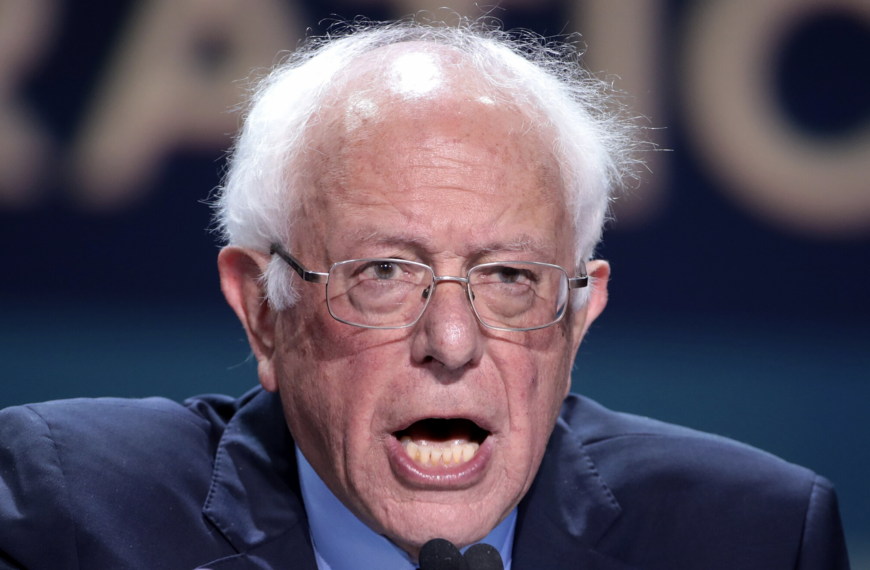


Sen. Bernie Sanders (I-Vt.) announced plans on June 1, 2026 to introduce sweeping legislation that would give the federal government a 50 percent ownership stake in the largest artificial intelligence companies in the United States — including OpenAI, Anthropic and Elon Musk’s xAI — paid not in cash but in company stock. The proposal, which Sanders calls the American A.I. Sovereign Wealth Fund Act, would use those shares to establish a publicly owned fund that Sanders says would ultimately redirect trillions of dollars in AI-generated wealth back to American citizens.
The senator, the senior independent from Vermont, outlined the plan in a June 1 op-ed published in The New York Times, arguing that the technology underpinning artificial intelligence was built not by Silicon Valley alone, but by the accumulated knowledge of generations of ordinary people — and that those people are owed a return on that contribution.
The Legislation
At the core of Sanders’ proposal is a one-time, 50 percent stock levy on the country’s dominant AI companies. The bill would not tax corporate profits in the traditional sense. Instead, companies like OpenAI, Anthropic, and xAI would be required to transfer half of their equity directly into a federally administered sovereign wealth fund. The government would then hold those shares on behalf of the American public.
The legislation is designed to accomplish two primary goals, according to Sanders. First, the federal government would gain voting rights and equal board representation at each of the major AI companies, giving the public a formal seat at the table in decisions that Sanders says currently happen with “virtually no democratic input.” Second, the fund would serve as a vehicle for distributing the financial gains of AI broadly across the population, rather than concentrating them among a small group of technology executives and investors.
“This legislation would give the public a direct role in determining the future of this technology,” Sanders wrote. “No longer would the future of A.I. and the transformation of human life that it will bring be dictated by a handful of Big Tech oligarchs.”
The Wealth Fund Model
Sanders has pointed to existing sovereign wealth fund models as proof of concept. Norway’s government-run sovereign wealth fund, seeded from the country’s oil revenues, is now valued at more than $2 trillion and was designed to ensure the country’s natural resource wealth flowed to its citizens rather than exclusively to private interests. Sanders argues that artificial intelligence represents a comparable national resource — one built on human knowledge rather than hydrocarbons.
Closer to home, the senator cited Alaska’s Permanent Fund, established roughly 50 years ago using state oil revenues, which has paid annual dividends directly to Alaska residents for decades. Sanders also noted that public pension funds across the country already hold hundreds of billions of dollars in corporate equity, and that even President Donald Trump signed an executive order proposing the creation of an American sovereign wealth fund — though with no specific AI focus.
“Dozens of sovereign wealth funds exist all over the world to ensure that ordinary people benefit from national wealth,” Sanders wrote. “Instead of a few oil executives pocketing all the benefits of this national resource, Norway made the decision that this wealth should be used to improve life for all of its people.”
Industry Leaders Have Made Similar Calls
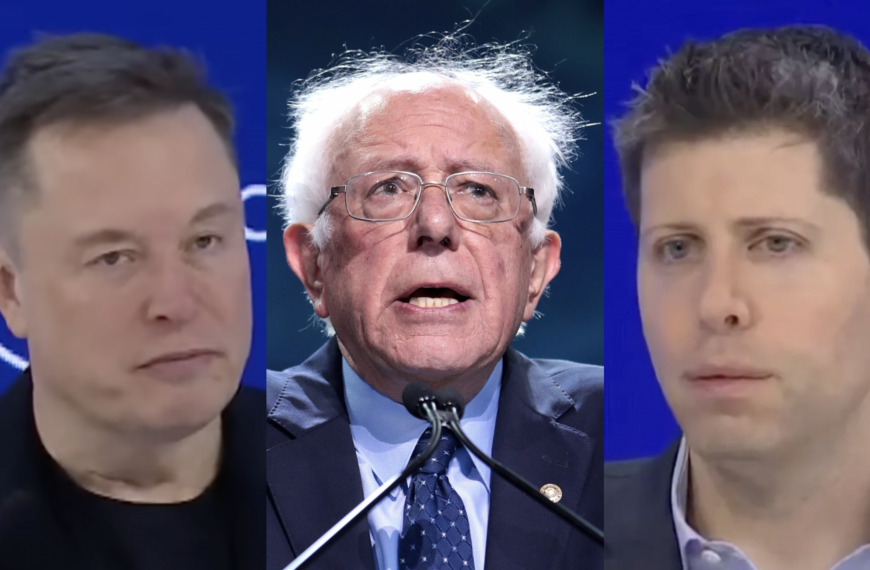
Perhaps the most striking element of Sanders’ pitch is his use of the AI industry’s own words to support the proposal. OpenAI itself, Sanders noted, has previously called for the creation of a “public wealth fund that provides every citizen — including those not invested in financial markets — with a stake in A.I.-driven economic growth.” Anthropic, the company led by Dario Amodei, has similarly proposed the establishment of “national sovereign wealth funds with stakes in A.I.” Even Elon Musk, who runs xAI, wrote publicly that “Universal HIGH INCOME via checks issued by the Federal government is the best way to deal with unemployment caused by AI.”
Sanders cited each of these statements directly, using them to argue that his legislation is not a fringe position but rather a policy direction that has been endorsed, at least in principle, by the very companies his bill would directly affect.
The Argument for Public Ownership
Central to the Sanders argument is the claim that AI companies did not build their technology in a vacuum. The datasets used to train large language models and generative AI systems, he contends, were drawn from books, journalism, scientific research, artwork, code, conversations, and creative works produced by millions of people across generations — none of whom consented to or were compensated for the use of their contributions.
“For the most part, tech oligarchs have fed this knowledge into their A.I. models without permission, without acknowledgment, without compensation,” Sanders wrote. “The creative work of millions of people — writers, artists, musicians, journalists, teachers, scientists and ordinary citizens — has essentially been stolen by some of the wealthiest people in the world.”
He noted that OpenAI’s own chief executive, Sam Altman, has acknowledged that AI models were trained on humanity’s “collective experience, knowledge” and “learnings,” language Sanders turned back on the industry as justification for public ownership.
What the Money Would Do
Sanders described the initial use of proceeds from the wealth fund as providing “direct payments to the American people.” As the fund grows in value alongside the AI sector — which analysts project could generate trillions of dollars in economic output — Sanders says the proceeds would be directed toward guaranteeing what he described as “a decent and dignified standard of living,” including access to health care, education and housing.
The senator acknowledged that the mechanics of having the government hold equity in companies for which AI is only one part of a larger business are complicated, and said fuller implementation details would be included in the formal legislation when it is unveiled in the coming weeks. This legislation builds on Sanders’ broader pattern of AI-related proposals in 2026, which has also included the AI Data Center Moratorium Act, co-introduced with Rep. Alexandria Ocasio-Cortez (D-N.Y.) in March, calling for an immediate federal pause on new AI data center construction until national safety safeguards are in place.
“The principle is simple,” Sanders wrote. “When a public resource generates wealth, the public should share in that wealth. A.I. is being built on a public resource far more valuable than oil: the accumulated knowledge, creativity and labor of mankind.”

 By
By


 By
By