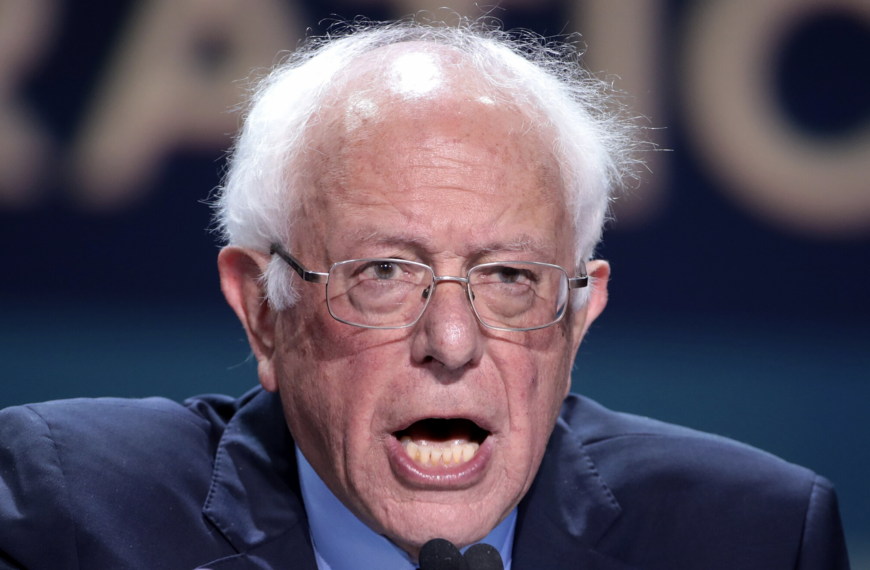


Senator Bernie Sanders has issued a sweeping warning about artificial intelligence, arguing that the technology is advancing without sufficient safeguards and could undermine jobs, privacy, democracy, and even humanity itself. In his call for federal action, Sanders says Congress must intervene before AI development accelerates further without democratic oversight, framing the issue as one of control over a rapidly transforming technological era.
Sanders points to growing public unease about AI’s impact, citing a Quinnipiac poll showing that 55% of Americans believe AI will do more harm than good, while 70% expect it to reduce the number of jobs available. The same survey found that only 5% of respondents believe AI development is being guided by organizations that represent the public’s interests. He argues that these results reflect widespread skepticism about who is ultimately shaping the technology and for whose benefit.
70% think AI will lead to fewer jobs.
— Sen. Bernie Sanders (@SenSanders) April 3, 2026
They are right.
We can’t allow a handful of billionaires, eager to increase their wealth and power, to rush forward with a technology that will fundamentally transform humanity without democratic input or accountability. pic.twitter.com/Jn4hgvEieh
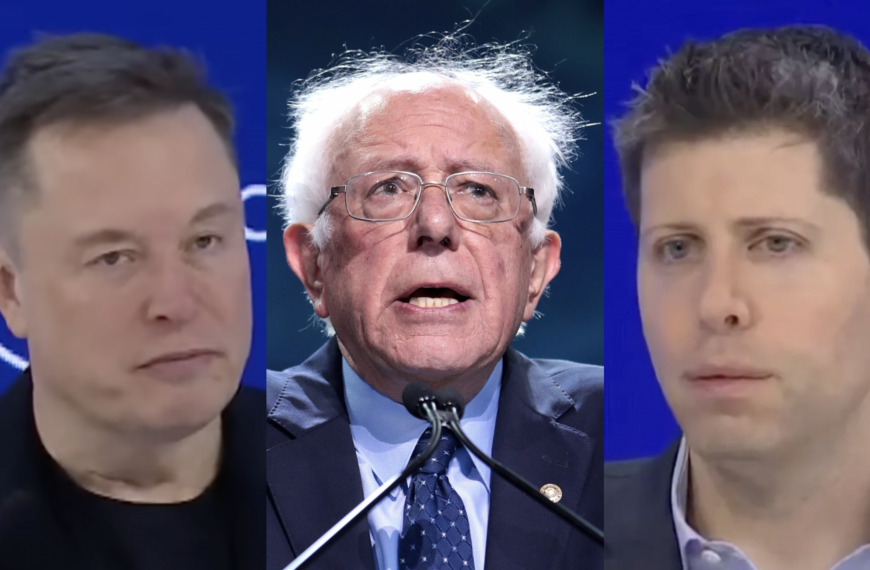
The senator also highlights concerns about inequality, noting that the AI revolution is being driven by some of the wealthiest figures in the country. He names billionaires such as Elon Musk, Jeff Bezos, Mark Zuckerberg, and Larry Ellison as major investors in AI and robotics, arguing that the direction of development is closely tied to concentrated economic power. Sanders cites warnings from industry leaders, including Musk’s statement that “AI and robots will replace all jobs,” and Bill Gates’ view that humans will not be needed “for most things,” using these comments to question how workers will sustain livelihoods if machines take over large portions of economic activity.
AI and robots will replace all jobs.
— Elon Musk (@elonmusk) October 21, 2025
Working will be optional, like growing your own vegetables, instead of buying them from the store.
Beyond the labor market, Sanders raises concerns about how AI is reshaping social relationships, particularly among younger people. He references a Common Sense Media poll finding that 72% of U.S. teenagers have used AI companions, with more than half doing so regularly. He argues that this trend raises questions about isolation and the nature of human connection, as digital systems increasingly substitute for interpersonal relationships.
Privacy is another central concern in Sanders’ argument. He warns that AI’s ability to analyze vast quantities of personal data at high speed could intensify surveillance capabilities. He cites Larry Ellison’s prediction of an AI-enabled system in which “citizens will be on their best behavior, because we’re constantly recording and reporting everything that is going on,” presenting it as an example of how far-reaching data monitoring could become if left unchecked.
Sanders also points to risks for democracy and the environment, including the rise of deepfakes that can blur the line between real and synthetic media, potentially undermining trust in public discourse. He highlights the growing energy demands of AI infrastructure, noting large-scale data center construction such as a Meta facility in Louisiana described as nearly the size of Manhattan and expected to consume electricity equivalent to 1.6 million homes. He argues that such expansion could increase reliance on fossil fuels during an ongoing climate crisis. He further cites warnings from leading AI researchers like Geoffrey Hinton and Yoshua Bengio about potential existential risks, alongside a 2023 open letter signed by more than 1,000 AI experts calling for a temporary pause in advanced AI development. Sanders also points to industry lobbying, stating that AI firms have spent more than $185 million to resist regulatory efforts. In response, he says he has introduced legislation with Representative Alexandria Ocasio-Cortez to impose a federal moratorium on new AI data centers until stronger safeguards are established, arguing that “the future of AI must be decided by the American people.”

 By
By

 By
By