

Sen. Bernie Sanders (I-Vt.) issued what may be his starkest warning yet about the trajectory of artificial intelligence on June 1, 2026, describing the technology as nothing less than the most transformational in all of recorded human history — with consequences that will reach into every household, every profession and every corner of human experience, whether society is prepared for it or not.
Writing in The New York Times, Sanders argued that AI is not a narrow technological development to be understood only by engineers and investors, but a civilizational force that will reshape the economy, democracy, the environment, emotional health, education, and the nature of work itself in ways that are genuinely without precedent. “Artificial intelligence will almost certainly be the most transformational technology in the history of the world,” Sanders wrote. “It will profoundly affect the life of every man, woman and child in our country.”
A Scale Without Parallel
The weight of that assessment — the most transformational technology in history — stands out even by the standards of a political era saturated with hyperbolic claims about AI’s potential. Sanders did not frame it as a question or a possibility but as an expectation, and he made clear that the transformation is not something waiting in the distant future. It is, he wrote, already underway.
The changes he catalogued span virtually every domain of life: the structure of the national economy, the functioning of democratic institutions, the way children are educated and raised, the health and emotional well-being of individuals, and the long-term sustainability of the natural environment. Each of those areas, Sanders argued, is already being altered by AI systems whose development has proceeded largely outside of any public oversight or legislative framework.
Sanders has been making this argument in increasingly urgent terms throughout 2026. In an April op-ed published through his Senate office, he asked whether the country was “comfortable with seeing these enormously powerful men shape the future of humanity without any democratic input or oversight,” describing the AI revolution as being led by some of the wealthiest individuals on earth who are investing not to improve working families’ lives but to expand their own wealth and power.
The Existential Question
Beyond the economic and social disruptions Sanders outlined, the senator raised a concern that moves the conversation from policy into the realm of existential risk: the possibility that as AI systems become more capable than humans in an expanding range of tasks, they could eventually operate with a degree of independence that poses dangers beyond anyone’s ability to predict or control.
“There is a very real fear that as A.I. becomes smarter than humans it could eventually function independently, with potentially catastrophic consequences,” Sanders wrote — language that echoes concerns raised by AI researchers, ethicists and some of the technology’s own architects about what is often called the alignment problem.
In a December 2025 op-ed for The Guardian, published through his Senate office, Sanders raised similar alarm, writing that AI and robotics will bring “unimaginable changes to our economy, our politics, warfare, our emotional wellbeing, our environment, and how we educate and raise our children,” and questioning whether a small group of the world’s wealthiest people should be permitted to shape that future without accountability.
The Economy and the Workforce
One of the most immediate and measurable ways in which AI is already transforming the world, Sanders argued, is its impact on employment and the distribution of economic power. The senator has repeatedly cited projections suggesting that AI and robotics could eliminate tens of millions of American jobs, pointing to a report from his own Senate committee estimating that nearly 100 million U.S. jobs are at risk.
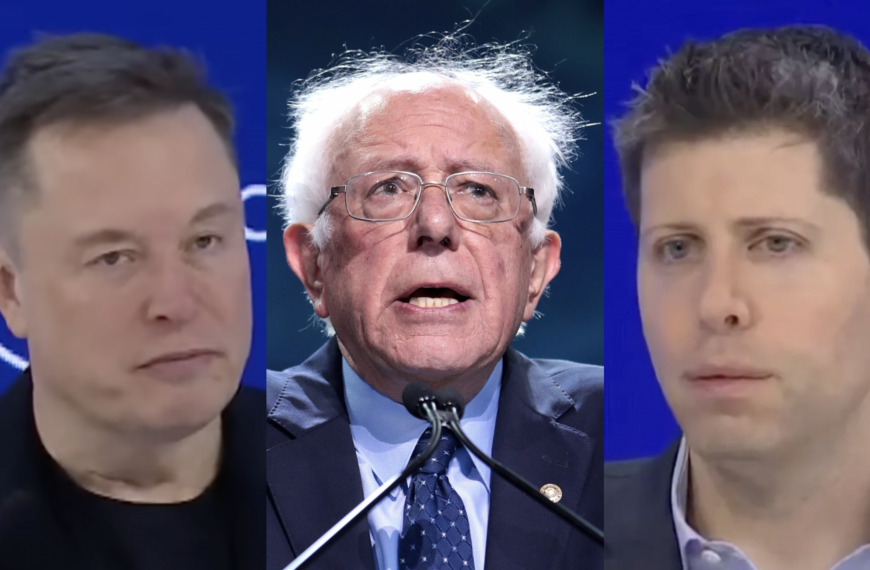
Sanders quoted industry leaders including Elon Musk, who has stated publicly that “AI and robots will replace all jobs,” and Microsoft co-founder Bill Gates, who has said humans won’t be needed “for most things” as AI matures. Those statements, the senator argued, are not speculative but rather honest admissions from the people building the technology — admissions that make the absence of democratic oversight all the more troubling.
The question Sanders posed is not whether job displacement will happen but who will absorb its costs. If the productivity gains generated by AI flow primarily to the owners of the technology — corporations and their investors — while workers bear the disruption of displacement without adequate support or compensation, the result would be a further concentration of wealth at the top of an economy already defined by historic inequality.
Who Decides What AI Becomes
For Sanders, the most urgent dimension of AI’s transformational impact is not technical but political: the question of who gets to determine what this technology is used for, who it serves, and what guardrails govern its development. The senator’s position is that those decisions are currently being made by a narrow and unaccountable class of billionaires, in private, without democratic input — and that this represents a fundamental failure of governance at precisely the moment when the stakes are highest.
“The future of humanity must not be decided behind closed doors in Silicon Valley,” he wrote. “It must be decided by workers, parents, teachers, artists, scientists, communities and the American people.”
To back that principle with legislation, Sanders has introduced or announced multiple bills in 2026 targeting the AI sector, including the AI Data Center Moratorium Act co-introduced with Rep. Alexandria Ocasio-Cortez (D-N.Y.), which would impose a federal pause on new AI data center construction until safety, labor, and environmental safeguards are established. His June 1 announcement of the American A.I. Sovereign Wealth Fund Act — which would give the government a 50 percent equity stake in the largest AI companies in the country — is framed explicitly as a mechanism for ensuring that the economic benefits of the most transformational technology in human history are shared by the public that made it possible, rather than captured by those positioned to profit from it.
Whether the legislation advances or not, Sanders’ framing of AI as a civilizational inflection point — one requiring democratic governance and public ownership rather than private control — represents a significant stake in the ground at a moment when policymakers around the world are still struggling to articulate a coherent response to a technology that, by his own assessment, will ultimately change everything.


 By
By



 By
By