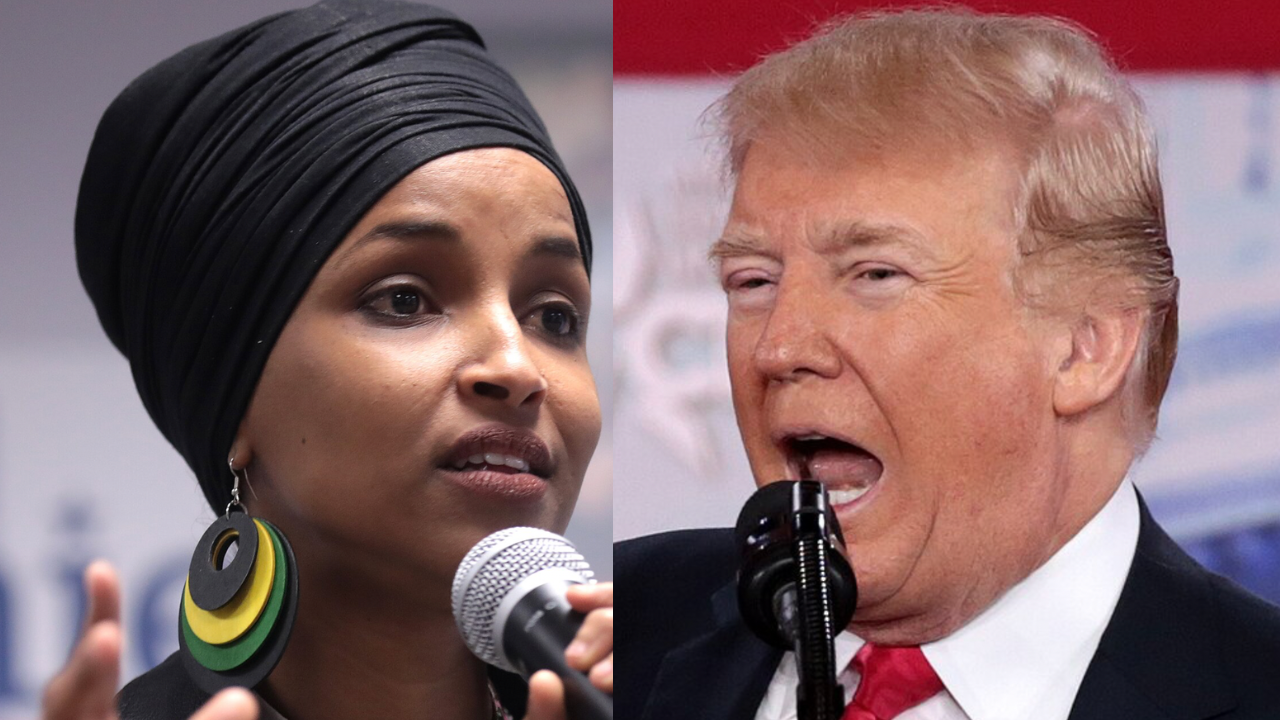

WASHINGTON, May 18, 2026 — Rep. Ilhan Omar, D-Minn., called Sunday for an outright ban on stock trading by the president and members of Congress after new federal disclosures revealed President Donald Trump was fined for disclosing tens of millions of dollars in tech stock trades months after the legal deadline — the third time he has been penalized for the same infraction.
“We need a ban on stock trading by the President and Members of Congress,” Omar wrote on X. “It’s [expletive] that elected officials are getting rich off the backs of the American people while having access to insider information.”
The disclosure filings, submitted May 14 to the U.S. Office of Government Ethics, showed Trump sold between $5 million and $25 million each of Microsoft and Amazon stock in February and purchased millions of dollars worth of the companies’ stock in March. Under federal law, the president is required to publicly disclose stock transactions exceeding $1,000 within 45 days. He was assessed a $200 fine for his tardiness — the same fine he was assessed in March and again in August of last year, according to the Washington Post.
A Pattern of Late Disclosures
The fine marks the third time Trump has been penalized for missing the 45-day disclosure window, according to his investment filings. Each fine is capped at $200 — a nominal amount critics have argued creates no meaningful deterrent for a president trading tens of millions of dollars in securities.
Trump has also yet to make publicly available his full 2025 financial disclosures, which were due Friday. Trump and Vice President JD Vance each requested and received a 45-day extension “to compile the necessary financial information and complete the report,” according to a White House official who spoke on the condition of anonymity.
Trump’s assets are held in a trust managed by his children — an arrangement that differs from the blind trusts used by previous presidents, which prevented their owners from knowing how their investments were being managed. The Trump Organization has said the president plays no role in selecting or directing specific investments. “Neither President Trump, his family, nor The Trump Organization plays any role in selecting, directing, or approving specific investments,” said Kimberly Benza, director of executive operations and communications for the Trump Organization. “They receive no advance notice of trading activity and provide no input regarding investment decisions or portfolio management of any kind.”
The Tech Trades at Issue
The Microsoft and Amazon trades are part of a broader pattern of tech-heavy activity in Trump’s first-quarter 2026 disclosures. Trump purchased Nvidia stock on February 10 — days before Nvidia announced a multiyear partnership with Meta to fill its new data centers with Nvidia processors. The company’s shares rose approximately 2.5 percent after the deal was announced. Trump also purchased Microsoft and Amazon stock months before the Pentagon announced deals to deploy their technology in classified computer networks, according to the Washington Post.
In all, the disclosures show Trump made more than 3,600 individual trades in the first three months of 2026, collectively worth between $211 million and $687 million — a dramatic shift from his first year back in office, when he largely invested in bonds rather than individual stocks.
The Legal Landscape
The president is not covered by the Stop Trading on Congressional Knowledge Act of 2012 — known as the STOCK Act — which requires members of Congress to disclose trades within 45 days and has been routinely violated by lawmakers of both parties. The president faces the same 45-day disclosure requirement under separate federal ethics law, but faces no statutory prohibition on trading individual securities while in office.
A ban on stock trading by the president would require an act of Congress. According to a Congressional Research Service analysis, at least 25 measures have been introduced in the 119th Congress to restrict or ban stock trading by federal officials. Among them: H.R. 7008, the Stop Insider Trading Act, introduced by House Administration Committee Chairman Bryan Steil in January, which would ban members of Congress and their families from trading individual securities — but would not cover the president. A separate House Democratic bill proposed last year would bar Trump, lawmakers, and their spouses from trading stocks, but that effort has stalled.
Eighty-six percent of Americans support banning members of Congress from trading individual stocks — including 87 percent of Republicans and 88 percent of Democrats — according to a University of Maryland Program for Public Consultation survey. Support for extending the same ban to the president, vice president, and Supreme Court justices stood at 87 percent.
Trump Called Hawley a ‘Pawn’ — Then Endorsed a Ban
The politics around a presidential stock trading ban grew particularly fraught last July when Sen. Josh Hawley, R-Mo., worked with Democrats to advance the HONEST Act — originally called the PELOSI Act — through the Senate Homeland Security and Governmental Affairs Committee by an 8-7 vote. The bill would ban members of Congress and their spouses from trading individual stocks, and included a provision applying the same ban to future presidents and vice presidents, though Trump and Vance were explicitly exempted.
Trump nonetheless attacked Hawley publicly, calling him a “second-tier Senator” and a “pawn” of Democrats. “The Democrats have been trying to ‘Target’ me for a long period of time, and they’re using Josh Hawley, who I got elected TWICE, as a pawn to help them,” Trump posted on Truth Social. Hawley clarified that Trump and Vance were fully exempted, and the two men later spoke by phone and smoothed over the dispute, with Hawley saying Trump told him “Oh, OK, great. This is good.”
Despite the confrontation, Trump himself called for a congressional trading ban at his State of the Union address earlier this year. “Let’s also ensure that members of Congress cannot corruptly profit from using insider information,” he said. Democratic Rep. Mark Takano of California shouted back from the floor: “How about you first?”
A Growing Democratic Chorus
Omar, a Workforce Protections Subcommittee Ranking Member and co-chair of the Defense Spending Reduction Caucus, has been one of the most vocal progressive critics of Trump’s financial dealings since his return to office. Her Sunday post was among the bluntest responses yet to the disclosure filings — joining a chorus that included Hillary Clinton calling the trades “textbook corruption,” Gov. Gavin Newsom calling them “corruption at the highest level,” Sen. Alex Padilla calling Trump “the most corrupt president in our history,” and Rep. Melanie Stansbury vowing the trades “will be investigated.”

 By
By

 By
By