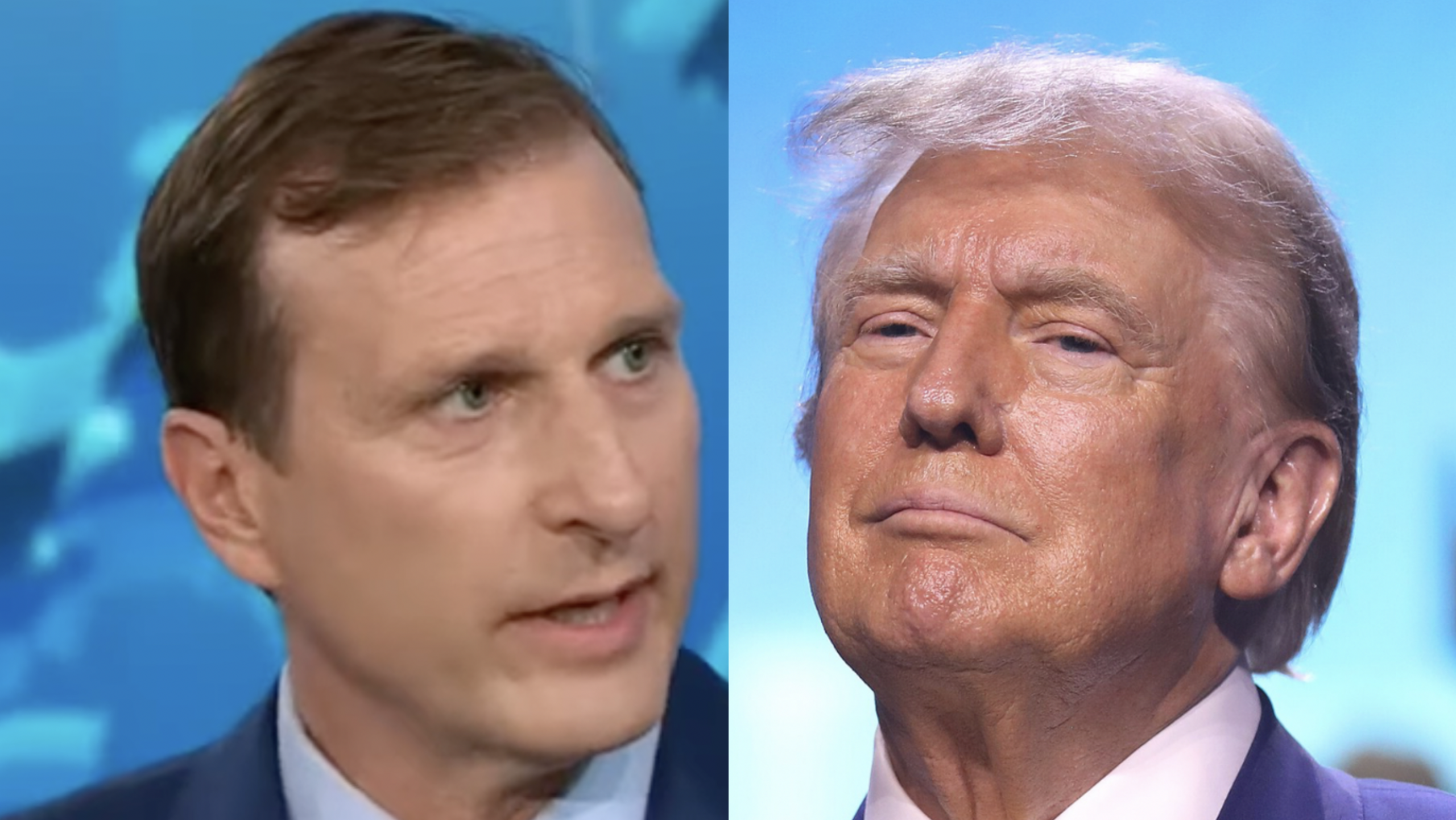

WASHINGTON, May 17, 2026 — Rep. Dan Goldman, D-N.Y., took to X on Saturday to accuse President Donald Trump of “blatant and criminal insider trading” after new federal disclosures revealed the president executed more than 3,600 individual trades — many in major artificial intelligence and technology companies — during the first three months of 2026, with transactions totaling between $220 million and $750 million.
“This smells like blatant and criminal insider trading,” Goldman wrote. “Even worse, Trump is personally profiting off of his illegal deportation dragnet. Since we know congressional Republicans will pretend like they never saw this and won’t do a thing, anyone involved in these trades should preserve their records for my investigation in January 2027.”
The post came in direct response to a NOTUS report revealing that Trump personally bought and sold millions of dollars worth of stock in technology companies and government contractors — including some of the most consequential names in the artificial intelligence industry — while his administration was simultaneously regulating, contracting with, and in some cases directly investing in those same companies. The disclosures were filed May 14 with the U.S. Office of Government Ethics.
The filings appear to offer the first public look in modern presidential history at an active public-markets portfolio in a sitting president’s name, documenting 3,642 individual trades made through the account in the first three months of 2026 — at a pace of roughly 60 trades per day. Since Lyndon Johnson pioneered the use of a presidential blind trust in 1963, every modern president has either placed their assets in a blind trust managed by independent trustees, held them in index funds and Treasuries, or liquidated all their assets.
At the center of Goldman’s concern is the striking overlap between Trump’s trades in AI chipmakers and the administration’s own regulatory decisions. According to the NOTUS report, Trump purchased between $1 million and $5 million worth of Nvidia stock on Feb. 10 — just one week before Nvidia announced a major computing deal with AI and social media giant Meta. Trump had also purchased between $500,000 and $1 million of Nvidia stock on Jan. 6, a week before the Commerce Department officially approved the sale of Nvidia chips to China. The documents reveal extensive exposure to some of Wall Street’s biggest names, particularly in technology and specifically AI.
AMD, another AI semiconductor company central to the race for advanced chip supremacy, was similarly tied to administration action. The Department of Commerce authorized AMD to sell chips to Chinese customers on Jan. 13. Trump had purchased between $50,000 and $100,000 worth of AMD stock on Jan. 6 — a week earlier — and bought at least $740,000 worth of AMD shares throughout the quarter. The AI chip sector has become perhaps the most strategically consequential industry in the world, with the U.S. government tightly controlling exports of advanced semiconductors to countries like China as part of a broader technology competition.
Goldman, who served as lead counsel during Trump’s first impeachment trial and as a former federal prosecutor in the Southern District of New York, specifically called out Trump’s trades in companies benefiting from the administration’s aggressive immigration enforcement — the “deportation dragnet” he referenced in his post. Chief among those companies: Palantir Technologies, whose AI-powered data software is now deeply embedded in federal law enforcement operations. Trump purchased at least $260,000 worth of Palantir stock during the first quarter, spanning purchases and sales across January, February, and March. In February, Palantir struck a billion-dollar agreement with the Department of Homeland Security to deploy its software in the administration’s deportation surge. The company also holds a contract surpassing a billion dollars with the Pentagon to develop AI systems for military targeting.
Axon Enterprise — the company behind Tasers and law enforcement technology — also appeared in the disclosures. Trump purchased between $1 million and $5 million in Axon shares on Feb. 10, with additional purchases in March. Immigration and Customs Enforcement outlined its plan to spend $220 million on Tasers over five years on Feb. 24, in what would represent a massive expansion of Axon’s federal business.
Goldman’s warning that those “involved in these trades should preserve their records” carries particular legal weight given his background. Before running for office, Goldman served as lead majority counsel in the first impeachment inquiry against Donald Trump and as lead counsel to House Managers in Trump’s Senate impeachment trial, directing strategy and overseeing the drafting of the investigation’s findings. His call for record preservation is a standard legal precautionary step, typically issued when investigators anticipate formal proceedings.
No charges have been made and no proven acts of insider trading have been outlined, but the revelations have drawn significant ethics scrutiny and a push for tighter trading restrictions. The filings do not specify whether Trump directed the trades. The White House pushed back firmly. White House spokesman Davis Ingle said the president’s assets are held in a trust managed by his children and that “there are no conflicts of interest,” adding that “President Trump only acts in the best interests of the American public.” The Trump Organization separately stated that the president, his family, and the organization play no role in selecting, directing, or approving specific investments, and that trades are executed through automated processes administered by third-party financial institutions.
Goldman’s pointed reference to congressional Republicans — predicting they would “pretend like they never saw this and won’t do a thing” — highlights the current legislative stalemate around stock trading reform. Despite unusually broad public support for tighter trading restrictions, the issue remains politically contentious. Republican and Democratic lawmakers disagree on whether officials should be required to fully divest existing holdings or simply stop purchasing new stocks, and there is disagreement over whether restrictions should apply to the president at all. A companion Senate version of a trading ban was introduced in January 2026 by Republican Senator Ashley Moody and Democratic Senator Kirsten Gillibrand, and has attracted more than 120 co-sponsors in the House.
The trading controversy is unfolding within a broader pattern of scrutiny surrounding Trump-era market activity. The Commodity Futures Trading Commission chairman, appointed by Trump, said his agency was investigating hundreds of possible cases of prediction-based trading connected to events during the administration — a separate but related dimension to the concerns Goldman is raising about direct stock trading in regulated companies.
At his last State of the Union address, Trump himself called on Congress to address the issue. “Let’s also ensure that members of Congress cannot corruptly profit from using insider information,” Trump said from the podium. Goldman’s post on Saturday — and his promise of a formal investigation in January 2027, when Democrats could potentially be in a stronger position to compel testimony and subpoena records — suggests he views that statement as an opening to hold the president to his own standard.

 By
By

 By
By