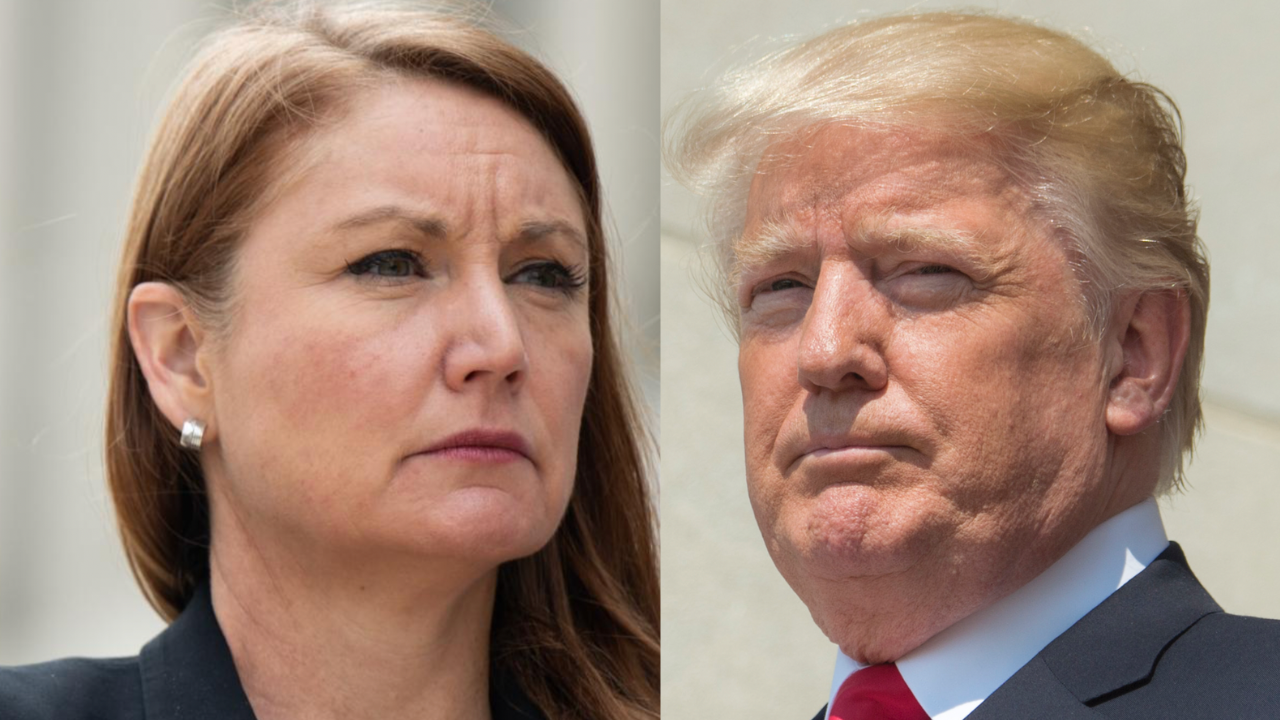

WASHINGTON, May 16, 2026 — Rep. Melanie Stansbury, D-N.M., called for an investigation into President Donald Trump’s stock trading activity Friday after new federal disclosures revealed he made more than 3,600 individual trades in the first three months of 2026 — including transactions in companies his administration was simultaneously regulating, contracting with, and hosting at the White House.
“Looks like potential insider trading to us,” Stansbury wrote on X, posting a screenshot of the Financial Times report on the disclosures. “Over 3,600 stock trades by Trump since Jan. Absolutely unprecedented. This will be investigated.”
The disclosures, filed May 14 with the U.S. Office of Government Ethics, show transactions collectively worth between $211 million and $687 million — involving securities in Nvidia, Palantir, Apple, Tesla, Meta, Visa, Citigroup, Boeing, Qualcomm, GE Aerospace, Paramount, Warner Bros Discovery, Netflix, Intel, Amazon, Microsoft, Adobe, Workday, Uber, and Costco, among others.
Scale and Timing
The volume of trading far exceeds anything Trump disclosed during the first year of his second term, when he largely avoided stocks and invested in corporate and municipal bonds. The first quarter of 2026 also marks his first major sale of assets since returning to office, including between $5 million and $25 million each of Meta, Amazon, and Microsoft securities, according to Financial Times analysis of the filings. In all, 2,346 securities were purchased and 1,296 were sold during the period. The filings do not specify whether the transactions involved stocks or bonds, and a number relate to ETFs or broad index trackers.
The trades coincided with a period of intense regulatory and procurement activity by the Trump administration affecting many of the same companies. The Commerce Department approved Nvidia chip sales to China in January. Palantir struck a billion-dollar contract with the Department of Homeland Security in February. Immigration and Customs Enforcement outlined a $220 million Taser contract benefiting Axon in February. The U.S. government took a nearly 10 percent direct ownership stake in Intel last year — a company whose shares have risen more than 200 percent so far in 2026, and in which Trump made six trades during the quarter.
The Beijing Connection
The disclosures also raised questions about Trump’s trades in companies whose chief executives accompanied him on his state visit to Beijing this week to meet Chinese President Xi Jinping. The filings show transactions involving Tesla, Nvidia, Apple, Meta, Visa, Citigroup, Boeing, Qualcomm, and GE Aerospace — companies whose CEOs were part of the approximately 30-member executive delegation Trump brought to the summit.
Trump wrote on Truth Social during the trip that it was an “honor” to have the business leaders along, singling out Nvidia CEO Jensen Huang as “the Great Jensen Huang.” He posted that he would ask Xi to “open up” China so that “these brilliant people can work their magic” — a statement made while holding disclosed positions in many of their companies.
There were also seven transactions relating to Boeing, including one purchase worth between $1 million and $5 million. U.S. special envoy Paolo Zampolli, who traveled with Vice President JD Vance to Hungary last month, also promotes Boeing sales overseas. “Whenever people see me, they want something. They want access to the president,” Zampolli told the Financial Times last month. “I tell them: ‘Buy Boeing.’ If you want to make the president happy, buy Boeing. It’s the simplest thing in the world.”
The Media Merger Angle
Paramount and Warner Bros Discovery — the two companies at the center of a $110 billion merger now under review by U.S. regulators — both appeared in Trump’s disclosed trades. There were also 17 transactions relating to Netflix, which was pushed out of its own bid for Warner Bros by Paramount’s offer. Trump has been publicly vocal about the Paramount-Warner merger and at times implied he favored Paramount’s offer. He has close ties to Oracle billionaire Larry Ellison, whose son heads Paramount Skydance.
The White House Response
The Trump Organization said the president plays no role in his investment decisions. “President Trump’s investment holdings are maintained exclusively through fully discretionary accounts independently managed by third-party financial institutions with sole and exclusive authority over all investment decisions,” a spokesperson said. “Trades are executed and portfolios are balanced through automated investment processes and systems administered by those institutions. Neither President Trump, his family, nor The Trump Organization plays any role in selecting, directing, or approving specific investments.”
The White House separately told reporters: “President Trump only acts in the best interests of the American public. President Trump’s assets are in a trust managed by his children. There are no conflicts of interest.”
The Legal Landscape
Federal ethics laws require the president to disclose stock trades in broad value ranges rather than exact figures — a lower bar than what applies to members of Congress under the Stop Trading on Congressional Knowledge Act of 2012, known as the STOCK Act, which requires disclosure within 45 days of a transaction. The president is not covered by the STOCK Act and faces no statutory prohibition on trading individual securities while in office, according to a Congressional Research Service analysis.
However, traditional insider trading law under Section 10(b) of the Securities Exchange Act of 1934 and SEC Rule 10b-5 prohibits trading on material non-public information by anyone — including the president. Whether trades made while possessing knowledge of pending regulatory decisions could constitute insider trading would be a matter for investigators and prosecutors to determine.
In the 119th Congress, at least 25 measures have been introduced to limit or ban stock trading by federal officials, according to the Congressional Research Service. H.R. 7008, the Stop Insider Trading Act, introduced by House Administration Committee Chairman Bryan Steil in January, would ban members of Congress and their spouses and dependents from trading individual securities — but would not cover the president.
At his last State of the Union address, Trump himself called on Congress to act. “Let’s also ensure that members of Congress cannot corruptly profit from using insider information,” he said. Democratic Rep. Mark Takano of California shouted back from the floor: “How about you first?”
Stansbury, a member of the House Oversight and Government Reform Committee, did not specify in her post which body she believed would conduct the investigation or under what authority.

 By
By

 By
By