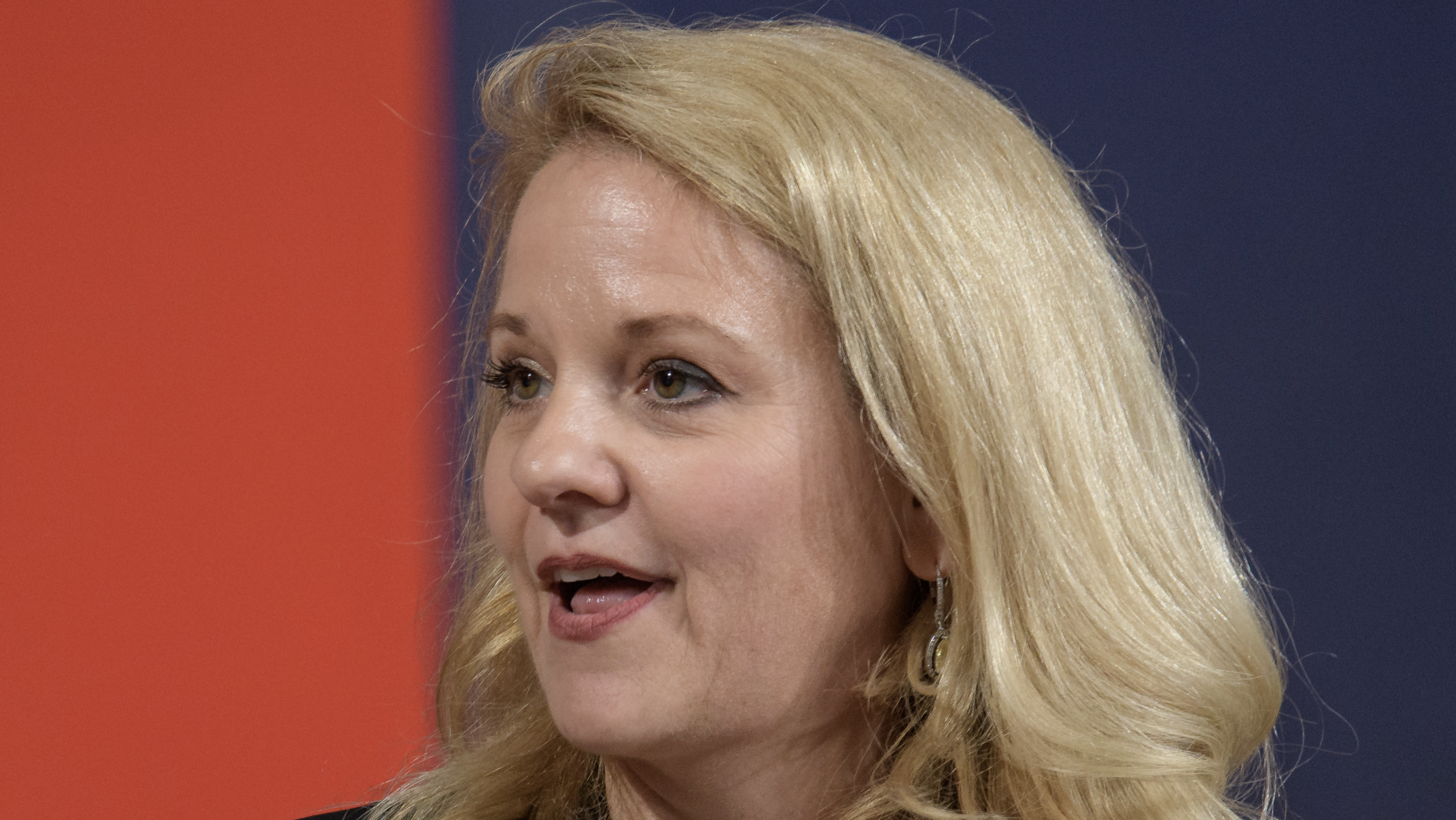

SpaceX President Gwynne Shotwell voiced strong support for President Donald J. Trump’s energy and artificial intelligence strategy during a White House event announcing the Ratepayer Protection Pledge, expressing confidence that the United States will outpace China in the global AI race while expanding electricity capacity for American communities. Her remarks came as leading technology companies gathered to commit to covering the costs associated with powering new AI data centers without passing those expenses to American ratepayers.
Speaking during the meeting, Shotwell praised the administration’s pace of policy changes related to energy development and AI infrastructure. “Mr. President, I want to thank you for your leadership. Because of your work on this issue, I’m confident we will win the race in AI with China and deliver abundant electricity for the American people,” she said. She added that the rapid construction of large-scale computing infrastructure underscores the urgency of expanding energy supply alongside technological development.
WATCH: @xai commits to develop 1.2 gigawatts of power as their supercomputer's primary power source:
— Rapid Response 47 (@RapidResponse47) March 4, 2026
"That will be for every additional data center as well. We will expand what is already the largest global Megapack power installation in the world. The installation will provide… pic.twitter.com/GJUYKWggdm
Shotwell described the scale of the infrastructure currently being built to support artificial intelligence systems. “AI builds super huge computers and data centers and we’re building them fast,” she said, noting that one major facility is currently under construction on the Mississippi state line. She said the company plans to take additional steps to ensure surrounding communities benefit from these projects while keeping electricity costs down.
Under the commitments discussed during the meeting, Shotwell outlined plans to expand power generation and grid infrastructure associated with new data centers. She said the facilities will rely primarily on solar energy and that additional backup power capacity will be developed using large-scale battery systems. “Our supercomputer’s primary power source will be solar, and that will be for every additional data center as well,” Shotwell said. She added that the project will expand what she described as the world’s largest Megapack battery installation, capable of providing backup electricity equivalent to the needs of a city the size of Memphis.
Shotwell also emphasized investments designed to strengthen local electrical infrastructure. “We will build new substations and invest in electrical infrastructure to provide stability to the area’s grid,” she said, describing those upgrades as an important component of supporting both the data center and the surrounding region.
In addition to energy infrastructure, she pointed to environmental measures planned for the project, including the construction of advanced water recycling systems. “We will build state-of-the-art water recycling plants to protect water in the aquifer each year,” Shotwell said, highlighting efforts to minimize the environmental impact of large-scale computing facilities.
Beyond the immediate infrastructure projects, Shotwell discussed broader ambitions for the role of artificial intelligence in society. She said the goal is to use AI technology to improve living standards and expand economic opportunity. “We also commit to deploying our AI technology to make people’s lives better, creating a period of abundance where electricity becomes cheaper and people have access to the best goods and services humankind has ever seen,” she said.
Shotwell also revealed that her team is exploring the possibility of moving some computing infrastructure into space. “Finally, Mr. President, we commit to take these efforts into orbit,” she said. “We are currently designing orbital data centers. Launching supercomputers into space will mean even more energy on Earth, as all of the power sources we’ve built will be available to the communities instead of the data centers.”
Reflecting on her decades in the aerospace sector, Shotwell said the current pace of technological and policy development stands out compared with earlier periods in the industry. “I’ve been in the space industry for nearly 40 years, sir, and I have never seen things move more quickly than under your administration,” she said. “You’ve been strong and clear about building AI that benefits Americans and benefits American values.”
Shotwell concluded by reaffirming her support and expressing enthusiasm about participating in the broader effort to expand AI infrastructure. “We’re fully on board with the Ratepayer Protection Pledge and I’m really excited to be here,” she said.
Shotwell currently serves as president and chief operating officer of SpaceX, the private aerospace company founded by Elon Musk. Widely regarded as one of the most influential executives in the modern space industry, she has spent nearly four decades working in aerospace engineering and satellite communications. Since joining SpaceX in 2002, she has played a central role in the company’s growth into a major launch provider and space technology developer, overseeing operations ranging from rocket launches to the expansion of satellite networks and advanced space systems.

 By
By


 By
By