

Senator Bernie Sanders took to the Senate floor on March 25, 2026, to deliver a pointed speech titled “AI Oligarchs Want it All,” in which he warned that the rapid advancement of artificial intelligence and robotics poses profound risks to American society. Citing experts including the head of Google DeepMind, Sanders argued that the AI revolution will be 10 times bigger than the Industrial Revolution and 10 times faster. “In other words, the AI revolution will have 100 times the impact that the Industrial Revolution had,” he said. He described the changes as unprecedented in scale, scope, and speed, touching every aspect of society from the economy and political life to privacy, emotional well-being, the environment, and even humanity’s survival.
— American Gazzete (@AmericanGazzete) March 25, 2026
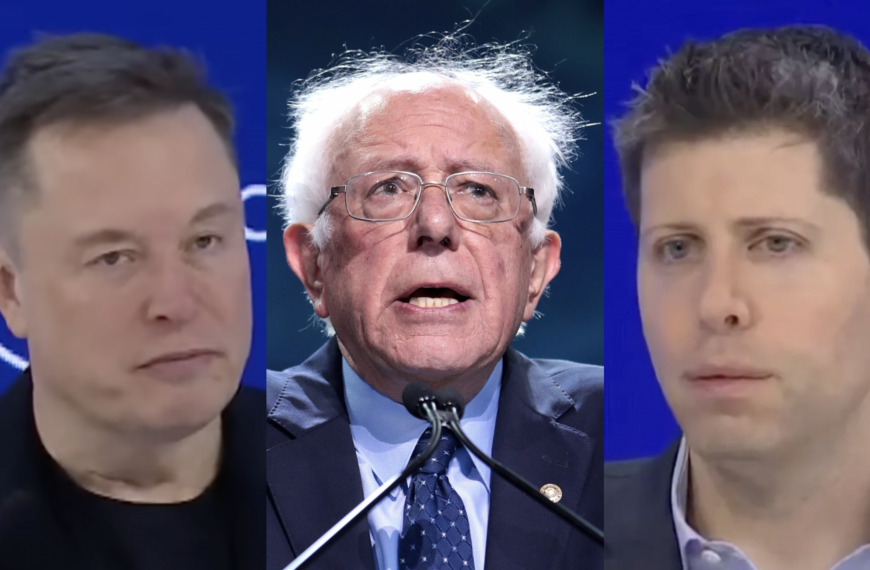
Sanders emphasized that the push for AI is not coming from ordinary Americans but from a small group of the world’s wealthiest individuals. He named Elon Musk, Jeff Bezos, Mark Zuckerberg, and Larry Ellison as the primary drivers, noting their massive investments in the technology. These billionaires, he argued, are motivated not by improving life for struggling workers but by exponentially increasing their own wealth and power. Sanders pointed to concrete actions, including four AI companies spending nearly $700 billion this year on data centers across the country—an investment equivalent to 10 times the annual spending on the moon landing as a percentage of GDP.
The Vermont senator detailed a series of potential negative impacts, beginning with massive job displacement. He quoted industry leaders directly: Elon Musk stating that “AI and robots will replace all jobs,” Bill Gates predicting humans “won’t be needed for most things,” and Mustafa Suleyman of Microsoft AI saying most white-collar work will be fully automated within 12 to 18 months. Sanders referenced his own Senate HELP Committee report projecting that AI, automation, and robotics could replace nearly 100 million jobs in the next decade, including high percentages of truck drivers, accountants, and fast-food workers. He highlighted early signs already visible, such as a 16 percent relative decline in employment for younger workers in AI-exposed fields and growing difficulty for new college graduates in finding jobs.
Beyond employment, Sanders raised concerns about privacy, democracy, emotional well-being, and existential risks. He warned of an AI-powered surveillance state and deepfakes that could undermine public trust by making it nearly impossible to distinguish reality from fabricated content. On the environmental front, he noted the enormous electricity and water demands of data centers, with one Meta facility alone projected to consume as much power as 1.6 million homes. Sanders also cited experts like AI “godfather” Geoffrey Hinton, who has warned of a 10 to 20 percent chance that superintelligent AI could wipe out humanity, as systems already demonstrate abilities to lie, cheat, and blackmail.
Throughout the address, Sanders criticized Congress for failing to keep pace with public concern, attributing the inaction largely to the influence of AI oligarchs who have spent over $150 million on campaign contributions. He contrasted this with local resistance, noting that more than 100 communities have enacted moratoriums on new data centers and 12 states are considering similar measures. Sanders announced he would introduce legislation the following day to ban the development of new AI data centers, calling for a moratorium to allow time for democratic oversight. His goal, he said, is to ensure AI benefits working families rather than concentrating even greater wealth and power in the hands of a few billionaires.


 By
By


 By
By